An in-depth guide to the McKinsey Problem Solving Game
Prepare for McKinsey Solve with a 2026 guide to Redrock, Sea Wolf, Sustainable Futures Lab, legacy Ecosystem, test-day rules, and practical prep strategies.
May 15, 2026 · 60 min read
What is the McKinsey Solve assessment?

McKinsey Solve is McKinsey’s online, game-based screening assessment for consulting applicants. It evaluates how you think (structure, prioritization, and decision-making under pressure) rather than what you already know.
It is also known as the Problem Solving Game (PSG), the Digital Assessment, or the Imbellus test (after the firm that built the first version). Same assessment family; the modules inside it have changed over time.
In 2026, most candidates report three modules: Redrock, Sea Wolf, and Sustainable Futures Lab (SFL). SFL is now quite common on 85-minute invitations, not a rare add-on. A 65-minute invite usually means Redrock and Sea Wolf only. Ecosystem Building is legacy: worth knowing about, but not your main prep focus.
Solve scores your final answers (product score) and also tracks how you work (process score): what you prioritize, what you click on, and how structured you are.
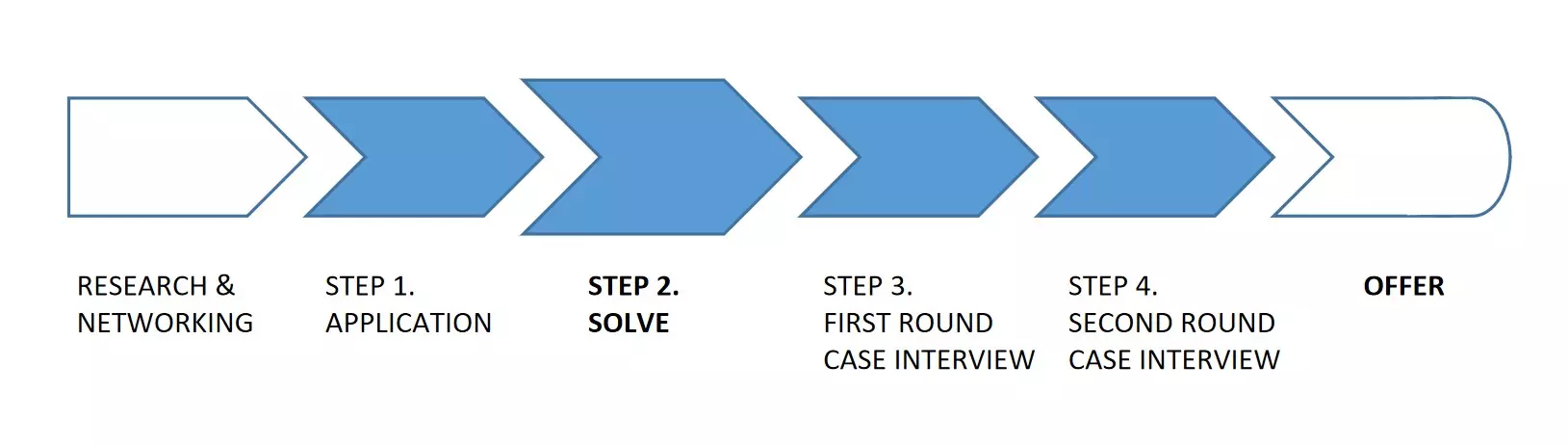
Where it fits in the process: you will typically receive an invitation shortly after applying. Plan to be ready within about one week of submitting your resume. Most consulting applicants take Solve; very few roles skip it. McKinsey weighs Solve results alongside your resume. Strong performance on both is usually needed to advance. See our consulting resume guide if you are still polishing your application.
The assessment is fully remote on PC or Mac. Always follow the rules in your invitation and on-screen instructions.
McKinsey Solve: quick answer
| Question | Answer |
|---|---|
| What is McKinsey Solve? | McKinsey’s online game-based assessment used in consulting recruiting. |
| Is it the same as PSG / Imbellus? | Yes. Older names for the same broad assessment family. |
| Current core games | Redrock, Sea Wolf, and Sustainable Futures Lab (SFL) on most 2026 invites. |
| Legacy module | Ecosystem Building, less common today, still referenced in older guides. |
| How long does it take? | Check your invitation. 65 minutes ≈ Redrock + Sea Wolf; 85 minutes often includes SFL. |
| Can you prepare? | Yes. You cannot memorize answers, but you can prepare for logic, timing, interface, and question patterns. |
We have tracked McKinsey Solve since 2017 and worked with hundreds of candidates through each format change. Solve is one of the most selective steps in the pipeline, a large share of applicants are screened out here. You can prepare meaningfully, but not by memorizing solutions; focus on the logic, pacing, and decision patterns each module rewards.
In this guide, we walk through what to expect on test day and how to approach Redrock, Sea Wolf, Sustainable Futures Lab, and legacy Ecosystem Building.
What changed in McKinsey Solve in 2026?
McKinsey Solve is no longer best understood as just the old Ecosystem game. Redrock, Sea Wolf, and Sustainable Futures Lab are the modules candidates most often report today, with SFL now a standard part of many assessments, not an occasional extra.
Ecosystem Building should be treated as legacy: less common, but still useful if you are reading older reports or guides.
Important: Always follow the exact instructions in your invitation email. Module mix, order, and timing can still differ by office, role, and region.
| Module | Current status | What it tests | Prep priority |
|---|---|---|---|
| Redrock | Core/current | Data selection, calculations, report logic, chart choice | High |
| Sea Wolf | Core/current | Constraint solving, averages, traits, trade-offs | High |
| Sustainable Futures Lab | Core/common (2026) | Judgment, prioritization, stakeholder trade-offs | High |
| Ecosystem Building | Legacy/less common | Food-chain optimization, ecosystem constraints | Low/medium |
McKinsey Solve test-day rules
Before you dive into game-by-game prep, understand the official constraints McKinsey communicates to candidates:
- Complete Solve alone. Do not receive help from anyone else during the assessment.
- No external tools unless accommodated. Do not use websites, AI tools (including ChatGPT), other applications, screenshots, recordings, or pre-prepared notes unless you have a written accommodation.
- PC or Mac only. The assessment runs on desktop or laptop, not mobile.
- Tech check first. You will run a technical check before the timed sections begin.
- Sound and mouse are optional. Audio is not required; a mouse is helpful but not mandatory.
- Duration is in your invitation. Check your email for the stated time, do not assume every version is identical.
- Untimed tutorials. Each task starts with an untimed tutorial. Use it to learn the interface.
- Technical issues: contact support immediately. If something crashes or locks you out, reach out to McKinsey support right away, not after you finish.
Always follow the rules shown in your invitation and on-screen instructions. Do not use external websites, AI tools, applications, screenshots, recordings, or pre-prepared notes. For scratch work or calculators, follow the instructions provided inside your assessment environment.
The Games

In 2026, most candidates see Redrock, Sea Wolf, and often Sustainable Futures Lab. Order varies by invitation. Below is what each module tests. Deeper walkthroughs and optimal scenarios are in our Solve prep on the platform.
Try the Redrock simulation · Try the Sea Wolf simulation
Redrock Case Study

Redrock is a timed, case-style module (investigation, analysis, report, and mini-cases) that closely resembles a traditional consulting assessment. Each section has its own time limit; you cannot bank unused time from one game in another, as you could in some legacy Solve versions.
The Redrock test consists of two main components:
The Study: three timed sections:
- Investigation: Collect data relevant to the case.
- Analysis: Answer questions based on the collected data.
- Report: Present your findings and conclusions.
The Mini-Cases: thematically related to the study but do not use the study's data. For example, if the study focuses on wolves, the mini-cases might include conservation questions, but not calculations on the specific study data.
All tasks are completed using the Redrock interface.
The Study
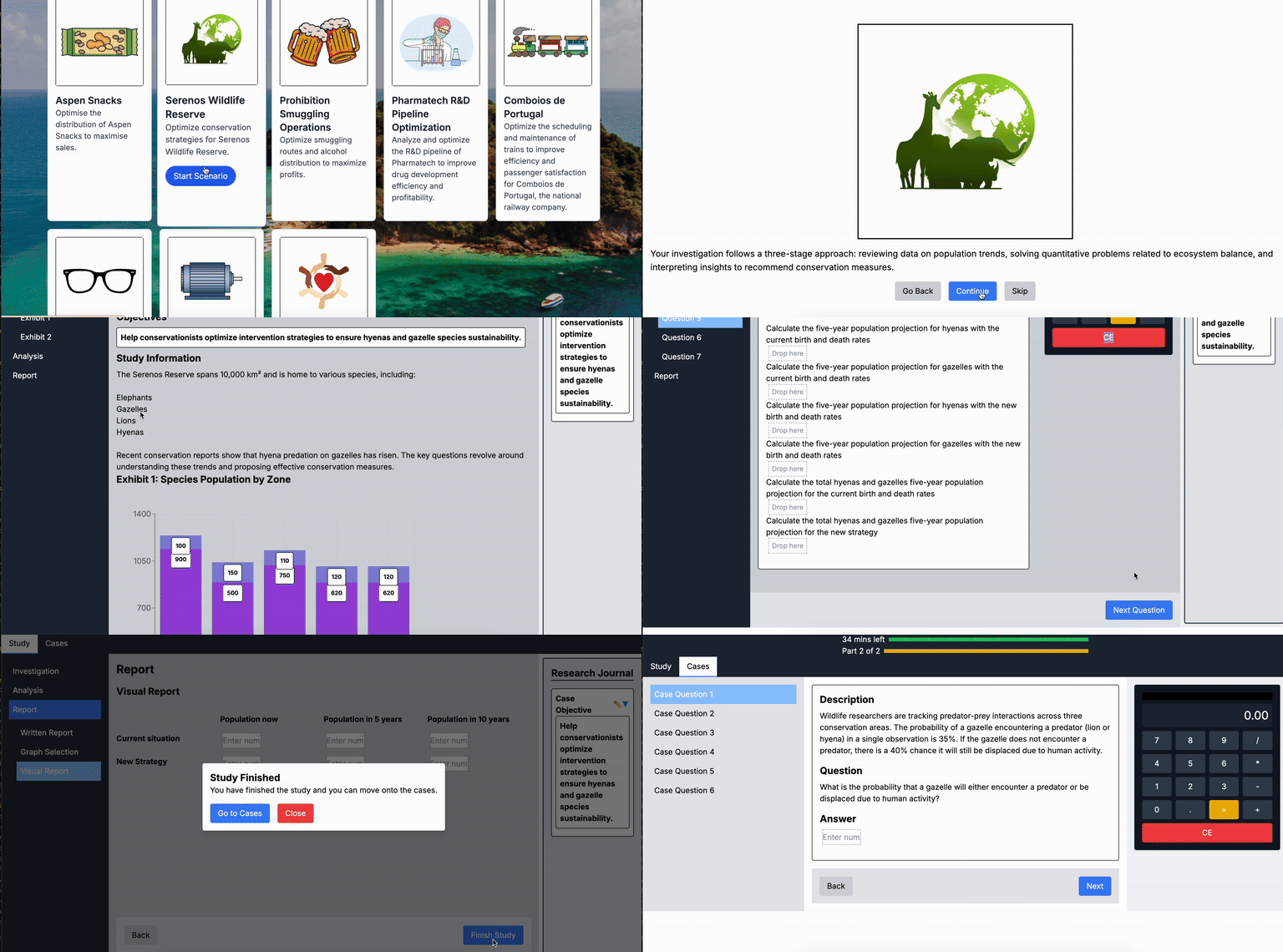
Redrock scenarios have evolved over time. You may not get the same setting as older candidate reports describe. Early versions centred on the Island of Redrock, a nature reserve where wolf packs across four locales depend on elk populations and you optimised pack sizes for ecological balance. Later iterations often asked you to assess which of three strategies could boost plant biodiversity (grasses, trees, shrubs) by a target percentage. In 2026, McKinsey may assign different case themes entirely. The wrapper changes, but the task structure does not.
No matter which scenario you get, you will always find the same elements:
- Initial scenario and proposed changes: a situation and proposed measures to improve it
- Bi-dimensional data: one set of data on a pivot table or stacked bar chart (e.g. species across locations)
- Charts: standard bar, line, and pie charts
- Report focus: questions that build toward a final recommendation and chart choice
Let's look at each section in more detail.
Investigation
Here, you have access to the full description of the case, with all the data on the various animal populations. Your task is to efficiently extract all the most salient data points and drag-and-drop them to your "Research Journal" workspace area. This is important, as you are also assessed on what data you select. This section tests your ability to understand the case and filter out relevant data through noise. For instance, if the case is about 4 animal species (wolves, elks, foxes and elephants), across 4 locations, and the case only focuses on 2 species in 2 locations, you will only need to drag data related to those 2 species in those 2 locations.
The animation above, from our Redrock simulator, shows the mechanics of the investigation section.
Investigation tip: Focus on case objectives, calculation instructions, and numerical data. Only about 10–15% of the numerical data is essential. Prioritize those figures. Start thinking about the report section now to predict what data you will need.
In the Redrock test, you can drag important data points into the Journal for collection, where they appear as labeled cards. These cards can be used in calculations or answering questions. You can edit labels for clarity and highlight key data with an "I" button for easier analysis.
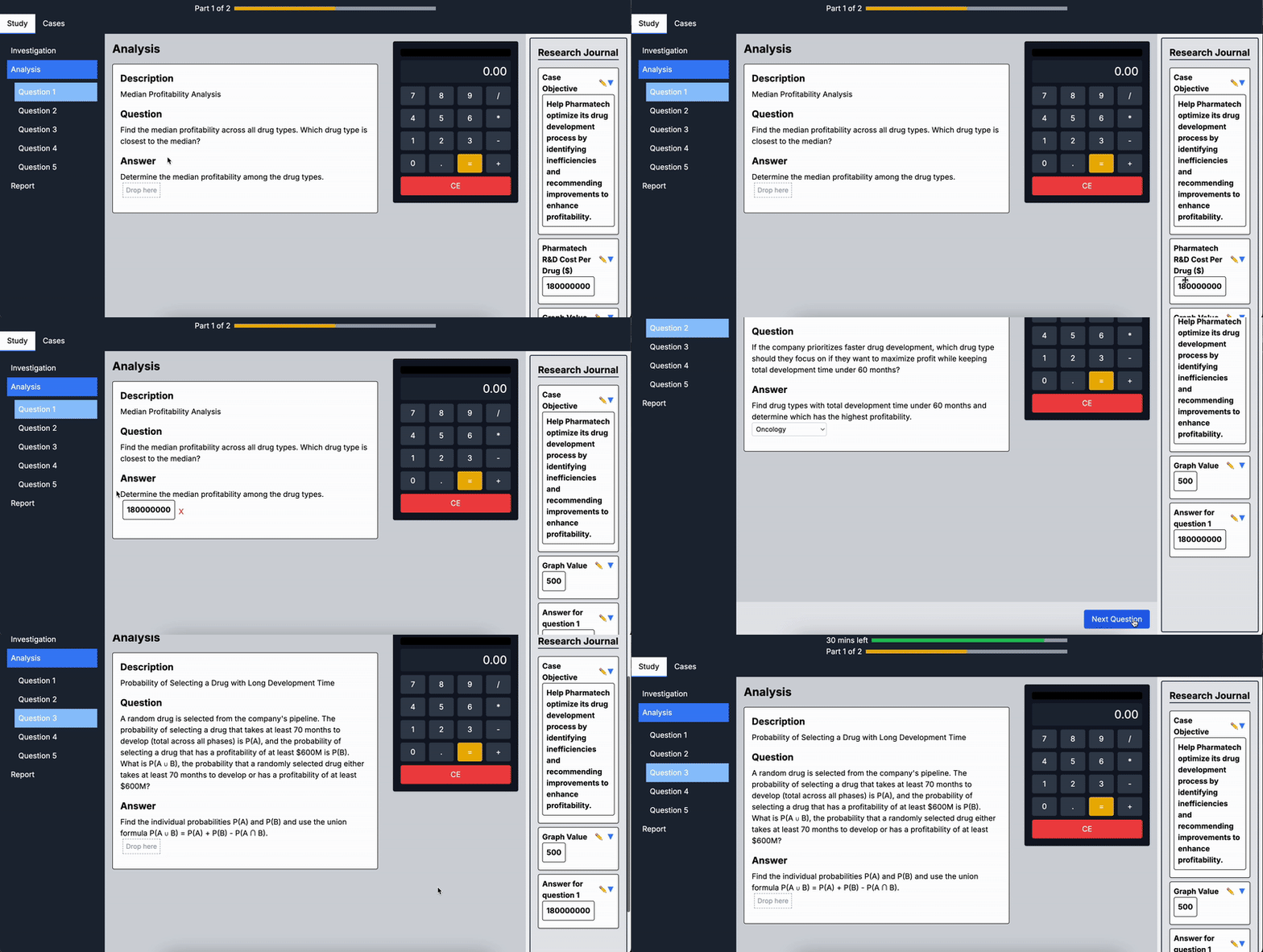
Analysis
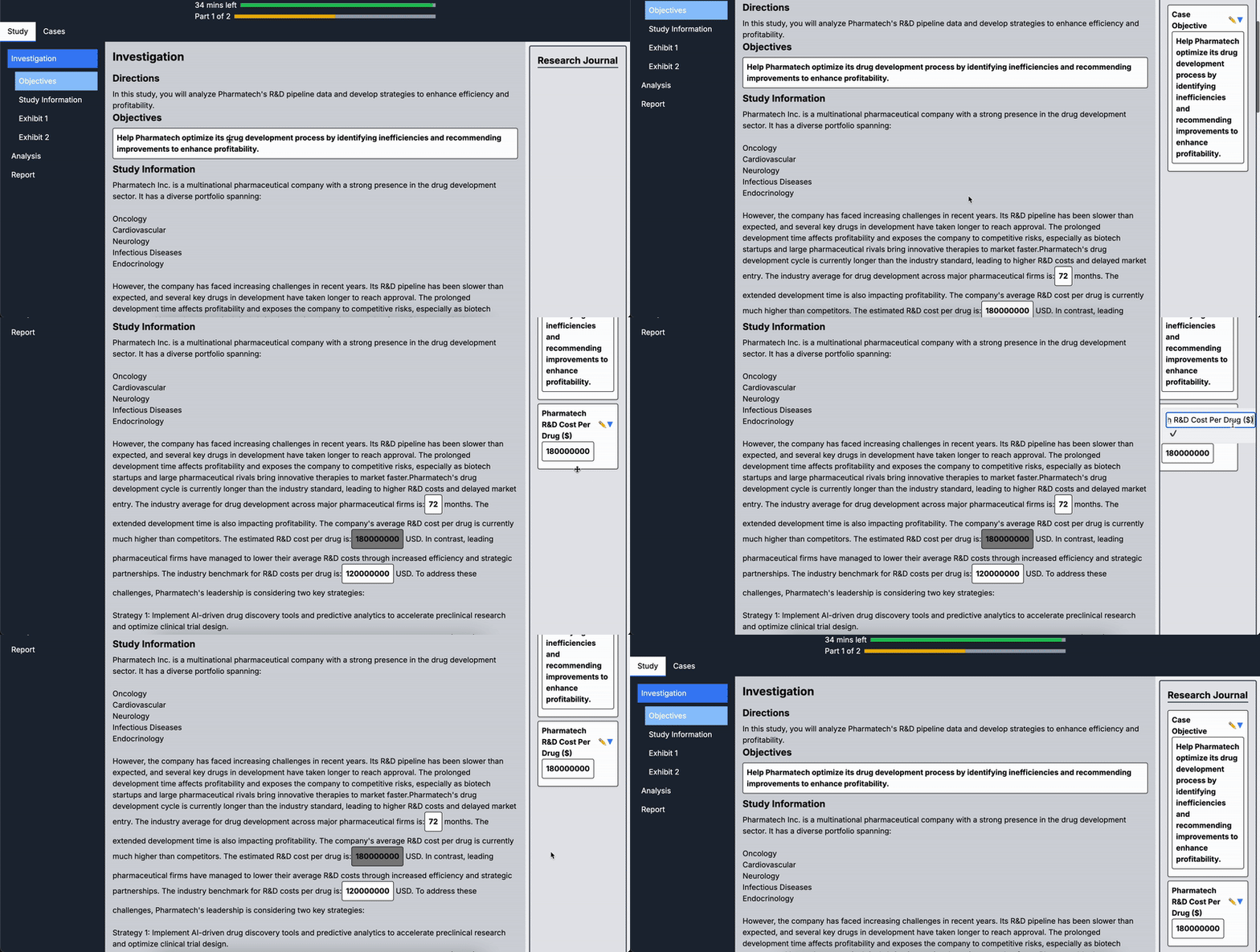
You will need to answer questions related to the case prompt using an in-game calculator. McKinsey logs your calculations to determine your score. Use the in-game calculator. You'll primarily perform basic operations like arithmetic, ratios, and percentages. The most complex task will be calculating compound growth rates, so ensure you're comfortable with these. Remember to collect your data in the journal. Our simulation automates this process for you.
Recent game iterations include questions on percentage points and probabilities, so be prepared for these as well. Our full simulation covers these topics, allowing you to practice effectively.
This section focuses on answering case questions. To prepare, practice with mock tests like ours, interview questions, and basic math problems. You can also review our consulting math material.
Avoid going back to the investigation section unless absolutely necessary, it costs time.
Report
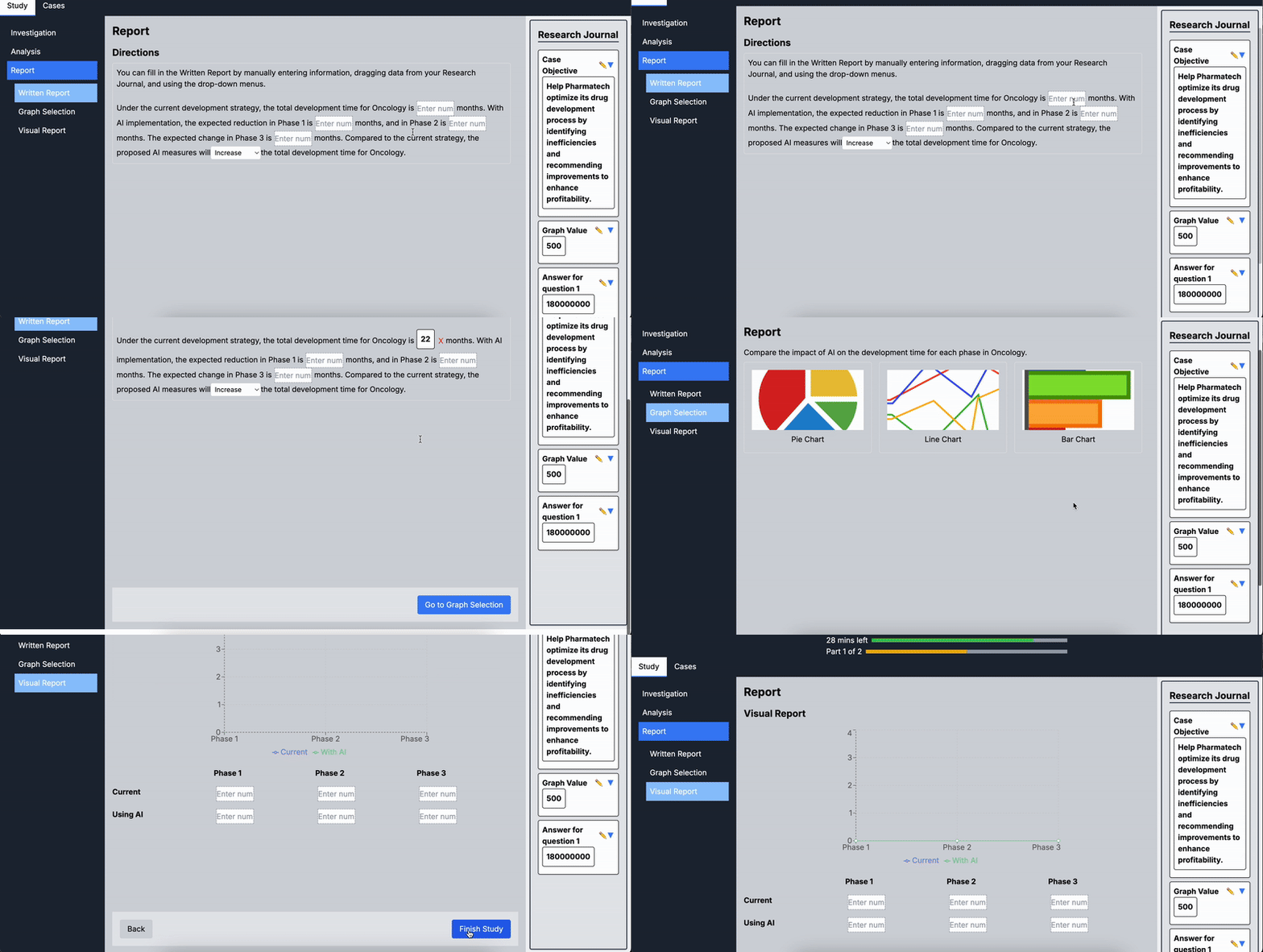
You must complete a pre-written report on the case topic, including calculating numerical values to fill in gaps and using an in-game interface to make a chart to illustrate your findings. You will leverage information saved in the Investigation section, as well as answers calculated in the Analysis section.
Point of no return: Once you start the report section, you cannot go back to analysis or investigation. Have all values and chart choice ready before you enter.
You will also have to choose a chart to display your results:
- Bar Chart: Comparing quantities across categories (e.g., sales by region).
- Line Chart: Trends over time (e.g., monthly revenue growth).
- Pie Chart: Parts of a whole, usually as percentages (use sparingly).
Visit our consulting math page for more details.
Mini Cases
The mini cases are thematically related to the study but do not use the study's data. If the study focuses on wolves, mini-cases might ask about conservation policy, not the wolf population numbers from your investigation.
These are standard business / MBA-style questions. They are very time-pressured. Skim the prompt, solve quickly, and move on. Common question types:
-
Calculation questions: weighted averages, probabilities, basic statistics.
- Weighted average: A retailer sells Product A ($50M revenue, 8% margin) and Product B ($150M revenue, 12% margin). What is the blended margin? → (50 × 0.08 + 150 × 0.12) / 200 = 11%.
- Probability (union): 30% of candidates are from City X, 25% from City Y, and 8% are from both. What share is from X or Y? → 30% + 25% − 8% = 47%. Do not simply add 30% + 25%.
-
Multiple choice questions: often four plausible options that differ in one detail.
- Example: “Revenue grew 12%” vs “Margin fell 3 percentage points”, the first is multiplicative growth; the second is a straight subtraction on the rate. Read every word; eliminate answers that confuse % with pp or use the wrong base.
-
Reading / analysis questions: interpret a chart, table, or short passage.
- Example: Monthly units sold: 8, 11, 11, 14, 20. The median is 11 (middle value when sorted). The mode is 11 (appears twice). Do not assume the mean equals the median without checking.
-
Formula-based questions: pick the right formula first, then plug in numbers.
- Example: A department’s budget share is 40% of total spend. A cut of 6 percentage points brings it to 34%. Subtract 6 from 40. A 6% reduction would mean 40% × 0.94 = 37.6%. The question wording tells you which operation to use.
-
Visualization tasks: choose the best chart for a stated objective.
- Example: “Show how market share of five competitors changed from 2019 to 2024” → line chart (trend over time). “Compare 2024 share across five competitors” → bar chart (category comparison). “Show distribution of customer ages in a survey” → histogram.
Mini-case timing: If you are stuck after ~45 seconds, eliminate obviously wrong options, pick your best guess, and move on. Leaving questions blank hurts more than a quick educated guess.
This is a brief summary, more detail is in our PDF Guide. Best prep: run our Redrock simulation (100+ Redrock-specific exercises included with your platform subscription).
Redrock: pitfalls and pacing
Test takers have noted some issues:
- Glitches/Crashes: Despite improvements, crashes still occur, sometimes locking candidates out of the assessment. If this happens, contact HR immediately.
- Poor Interface: Unclear navigation and a temperamental drag-and-drop feature waste time.
- Confusing Language: Complex, poorly phrased wording, especially hard for non-native speakers.
- Insufficient Time: Many candidates struggle to finish all questions under time pressure.
Pacing cheat sheet:
| Phase | Goal | Common mistake | Strategy |
|---|---|---|---|
| Tutorial | Learn interface | Rushing before understanding controls | Use the untimed tutorial properly |
| Investigation | Save only useful data | Collecting everything | Identify objective, formula, and relevant data first |
| Analysis | Calculate accurately | Going back and forth too much | Use saved data and keep calculations organized |
| Report | Complete final recommendation | Entering report without all values | Know required chart and final conclusion before moving on |
| Mini-cases | Answer fast | Spending too long on one question | Move quickly; use elimination when stuck |
Example question patterns you should recognize (not memorize):
- Percentage growth / percentage point change: e.g. revenue grows 12% year-on-year, but margin falls by 3 percentage points. Know when to multiply vs subtract.
- Weighted average: e.g. combining product-line revenues or weighted defect rates across sites.
- Chart selection: bar chart for category comparison, line chart for trends over time, pie chart for share-of-whole (use sparingly).
Practice these patterns in our Redrock simulation and consulting math guide.
Sea Wolf
Sea Wolf is a core McKinsey Solve module that McKinsey began rolling out widely from 2024. It is part of the official assessment for many candidates today, not a separate test from Solve. Older candidate reports sometimes call it Ocean Cleanup; same game.
Unlike Redrock’s case-style calculations, Sea Wolf is an interactive optimization game. You design bacterial treatments for three ocean sites. Each site uses the same four-step flow. You play the same round three times.
Objective
Your goal is to select a team of three microbes per site whose combined profile matches that site’s requirements. Effectiveness depends on numeric attributes (averaged across the three microbes) and traits (present or absent in your final group).
The game shares some surface similarities with legacy Ecosystem Building, but the logic is different: averages and trait rules, not food chains. We’ll walk through one site in detail; the process repeats for all three.
How the game works
The game revolves around seven key characteristics, grouped into attributes and traits:
- Attributes: Three continuous variables per microbe and per site, each ranging from 1 to 10. Each site specifies a target range for each attribute (e.g. permeability 2–4).
- Traits: Binary variables (e.g. aerobic vs anaerobic). Each site specifies one desirable trait and one forbidden trait.
- Microbes: Every microbe has 3 attributes and 1 trait.
- Microbe database: The full set of microbes available in the game.
- Prospect pool: A shortlist of 10 microbes you narrow down during play.
- Treatment team: Your final 3 microbes submitted for a site.
A valid treatment requires:
- The average of each attribute across your 3 microbes falls within the site’s range.
- At least one microbe has the desirable trait.
- None of the microbes has the forbidden trait.
Scoring
- 20% for each attribute where the average of the 3 selected microbes falls within the required range.
- 20% if at least one microbe has the desirable trait.
- 20% if none of the microbes has the undesirable trait.
The four steps (per site)
You go through four steps to arrive at the final 3-microbe treatment. Some steps may feel disconnected from the final result, that’s expected. Focus first on understanding the flow.
Step 1. Select site characteristics
Choose two characteristics (attributes or traits) for the site. If you pick an attribute, you define a range of 2 (e.g. 2–4, 4–6). For traits, you choose yes or no.
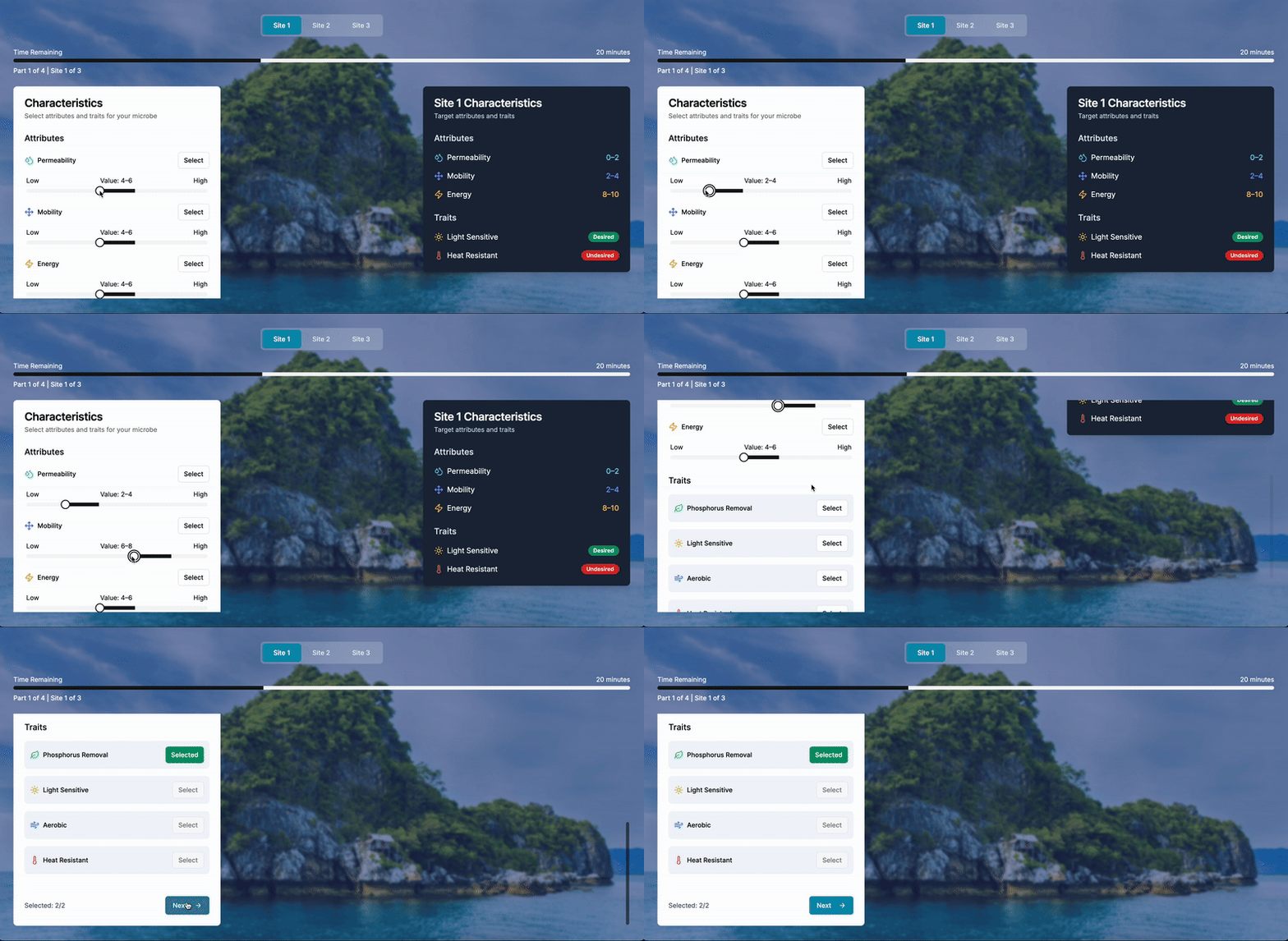
These selections are intended to influence which microbes appear in the next step, but the link isn’t always consistent. Pick characteristics that match the target site as closely as you can.
Step 2. Assign microbes
You’ll see the full profile for Site 1 (three attributes, desirable and forbidden traits) and partial info for Site 2. You’re given 10 microbes and must assign each one to:
- Site 1
- Site 2
- Reject
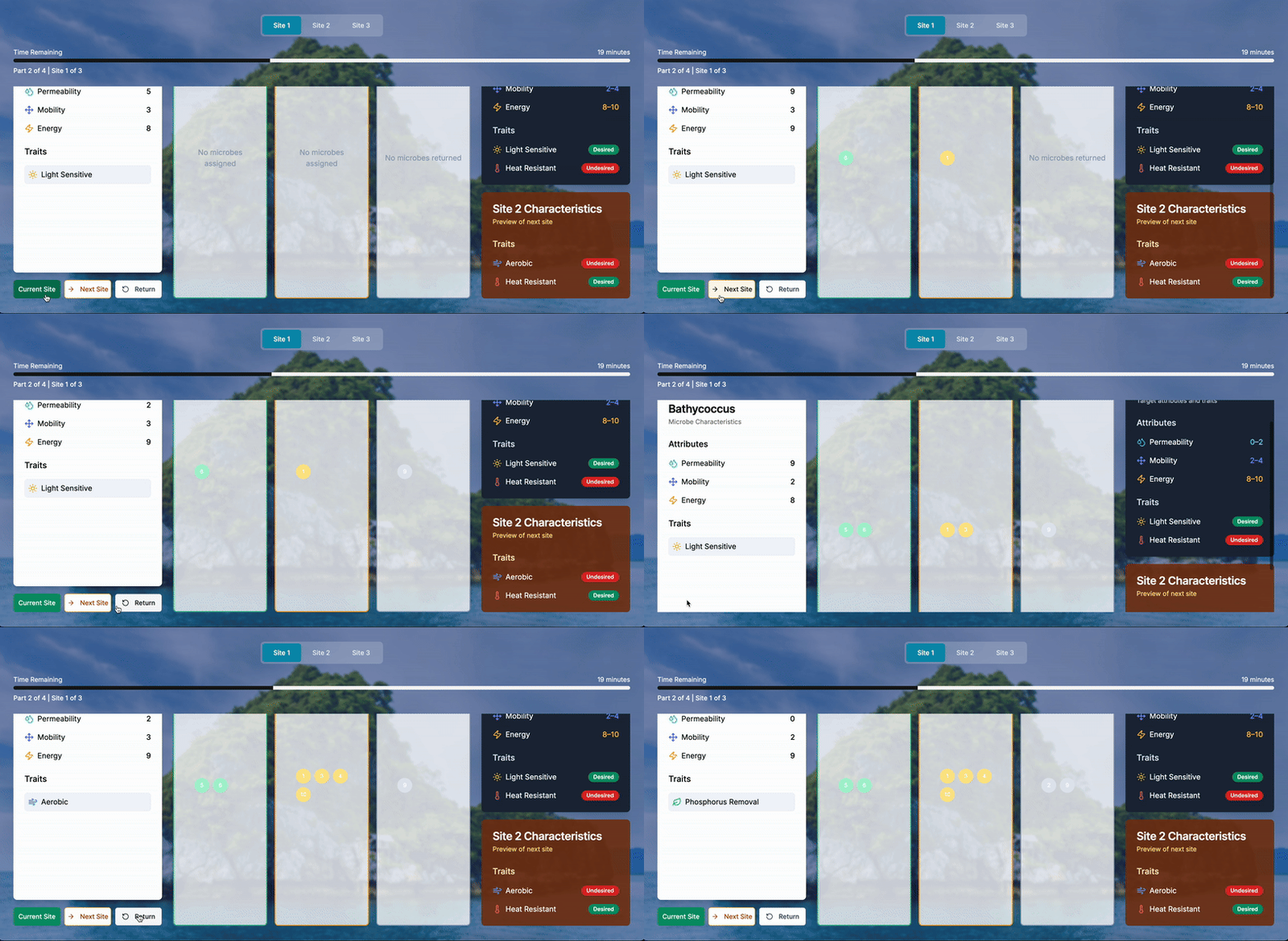
This step shapes your initial prospect pool. The distribution of assigned and rejected microbes can vary significantly across runs.
Step 3. Build the prospect pool
You’ll build a 10-microbe prospect pool. You’re given 6 microbes, then complete the set by choosing 4 more (one per round) from selections of 3.
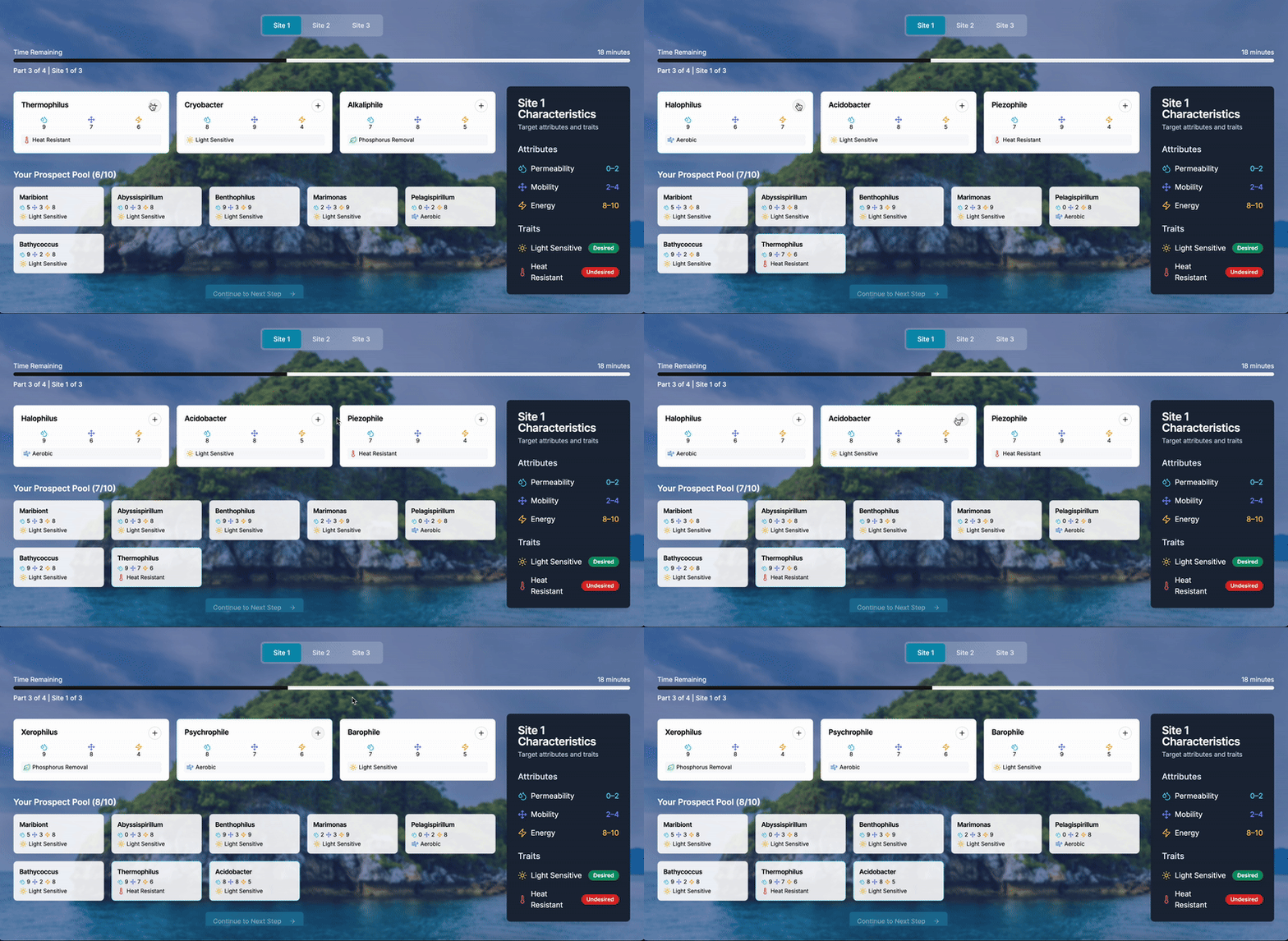
Each round, evaluate which candidate best suits the target site. Your final 3-microbe treatment will be chosen from this pool.
Step 4. Select the final 3 microbes
From the 10 microbes in your prospect pool, select 3 that best match the site when averaged:
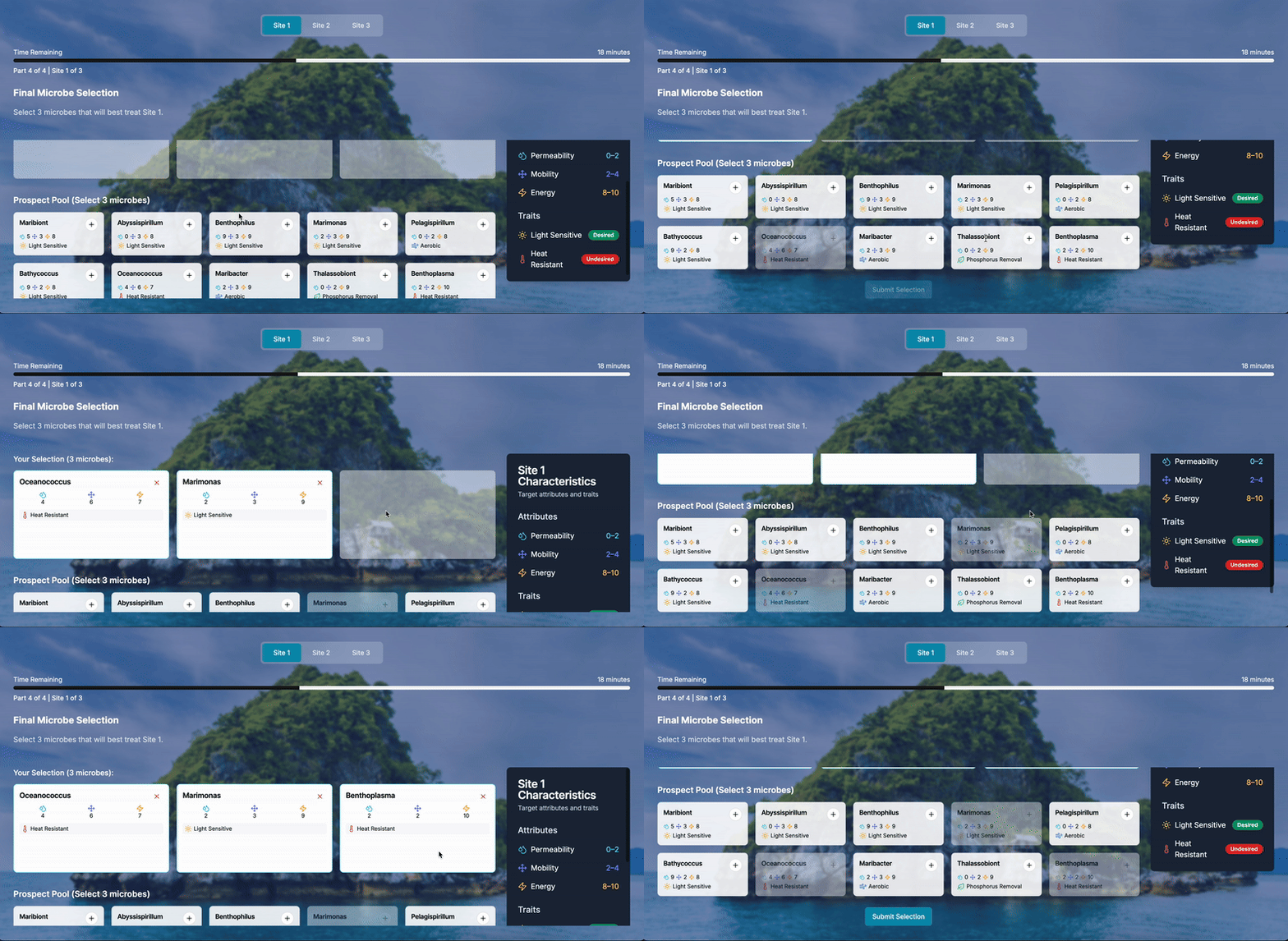
- The average of the 3 microbes’ attributes should fall within the site’s specified ranges.
- At least one microbe should have the desirable trait.
- None of the selected microbes should have the forbidden trait.
Strategy
Once you understand the four steps, use the same decision sequence for every site:
- Understand site constraints: target attribute ranges, one desirable trait, one forbidden trait.
- Remove options with forbidden traits.
- Keep options with desired traits (you need the desirable trait in at least one microbe in the final group).
- Combine candidates into groups of three.
- Average numeric attributes across the selected microbes.
- Check that the final group satisfies every constraint: all three attribute averages in range, desirable trait present, forbidden trait absent.
- Submit only after checking both numbers and traits.
Simplified example (fictional):
| Microbe | Attribute A | Attribute B | Trait | Keep / reject |
|---|---|---|---|---|
| A | 8 | 4 | Desired trait | Keep |
| B | 6 | 6 | Neutral | Keep |
| C | 10 | 5 | Forbidden trait | Reject |
| D | 7 | 7 | Neutral | Maybe |
If the site needs Attribute A between 6–8, a group of A + B + D might work even though no single microbe is perfect. The decision is about the group average, not each microbe individually. C is rejected immediately because of the forbidden trait.
Tips by step:
- Step 1: Initial parameter selection: Choose the site trait and one attribute that match the target site. This increases your chances of useful microbes in later steps.
- Step 2: Assigning microbes to Site 1: Pick bacteria only if they fall within range for two attributes and do not have the forbidden trait.
- Step 3: Choosing from three options:
- Eliminate any bacteria with the forbidden trait.
- Check for the desirable trait, you only need it once in your final group of three.
- Among remaining options, prefer bacteria with the most attributes in range.
- If none look strong, reassess your pool, you may already have one or two good candidates for the final team.
- Step 4: Final selection:
- Discard bacteria with forbidden traits first.
- Prioritise those with the desirable trait and at least two attributes in range.
- For your remaining slots, pick microbes whose combined averages hit the target, two weaker microbes can balance each other out.
- Pro tip: Instead of calculating the mean, sum the three attribute values. With three microbes, your target range becomes 3 × lower bound to 3 × upper bound.
On test day: Keep scratch work simple, basic arithmetic is enough. Avoid external tools or complex spreadsheets; they waste time.
Practice this logic in our Sea Wolf simulation.
McKinsey Solve Sustainable Futures Lab: complete guide
Sustainable Futures Lab is now a standard part of many McKinsey Solve invitations, especially on 85-minute versions. Not a rare or experimental add-on.
Unlike Redrock and Sea Wolf, it is not mainly a quantitative or optimization game. It is closer to a situational judgment assessment. You are placed inside a consulting-style project scenario and asked to make decisions as the situation evolves.
The setting is usually sustainability-related: for example, wetland restoration, pollution reduction, habitat recovery, water quality, biodiversity, or similar environmental topics. However, the sustainability theme is mostly the wrapper. The real test is not whether you know environmental science. The real test is whether you make structured, balanced, consultant-like decisions under uncertainty.
At a glance:
- Redrock tests data analysis and case-style reasoning.
- Sea Wolf tests constraint-solving and optimization.
- Sustainable Futures Lab tests judgment, prioritization, stakeholder management, and decision-making under ambiguity.
McKinsey has not publicly released a detailed official breakdown of Sustainable Futures Lab, so candidates should always follow the exact instructions in their invitation email and on-screen tutorial. Based on current candidate reports, SFL is now a standard module on many 2026 Solve assessments.
Sustainable Futures Lab: quick overview
| Question | Short answer |
|---|---|
| What is SFL? | A scenario-based judgment module inside McKinsey Solve. |
| What does it test? | Prioritization, uncertainty, messy information, trade-offs, and team/stakeholder effectiveness. |
| Is it quantitative? | Not really. It is much less calculation-heavy than Redrock. |
| Is it like Sea Wolf? | No. Sea Wolf is optimization; SFL is judgment. |
| How long is it? | Reportedly 20 minutes. |
| How many questions? | Reportedly 13 questions. |
| What question types appear? | 1 ranking question followed by 12 scenario-based multiple-choice questions. |
| How do I know if I have it? | Check your invitation duration. 85 minutes strongly suggests SFL may be included. |
| Can I prepare? | Yes, by practicing the decision patterns and common question types. |
65-minute vs 85-minute McKinsey Solve invite
The easiest way to know whether you are likely to receive Sustainable Futures Lab is to check the duration in your McKinsey Solve invitation email.
Current candidate reports suggest the following pattern:
| Invite duration | Likely modules |
|---|---|
| 65 minutes | Redrock + Sea Wolf |
| 85 minutes | Redrock + Sea Wolf + Sustainable Futures Lab |
If your invitation says 65 minutes, you are most likely preparing for Redrock and Sea Wolf only.
85-minute invite: Assume Sustainable Futures Lab may be included as a third module.
This is not something to guess. Check the email carefully. McKinsey may vary the assessment by office, role, region, and rollout stage.
Sustainable Futures Lab format: 20 minutes, 13 questions
The reported format for Sustainable Futures Lab is:
- 20 minutes
- 13 questions
- 1 initial ranking question
- 12 scenario-based multiple-choice questions
- Sequential project storyline
- No heavy calculations
- No chart-building
- No spreadsheet-style data analysis
- Mostly text-based decision-making
The questions are not isolated. They usually follow one project scenario from beginning to end. You start with a project background, then new information appears as the case develops.
For example, in a wetland restoration scenario, you may first need to structure the project, then deal with conflicting ecosystem data, then respond to stakeholder pressure, then decide how to synthesize the final recommendation.
This means consistency matters. The test is not only asking, “Can you pick a good answer once?” It is also asking, “Can you keep making sound decisions as the facts change?”
The first question: ranking / prioritization
Question 1 is usually a drag-and-drop ranking: you order four possible next actions from highest to lowest priority.
The common mistake is to gather more information before you have a hypothesis. Strong candidates usually structure the problem first, then use data and stakeholder input to test it.
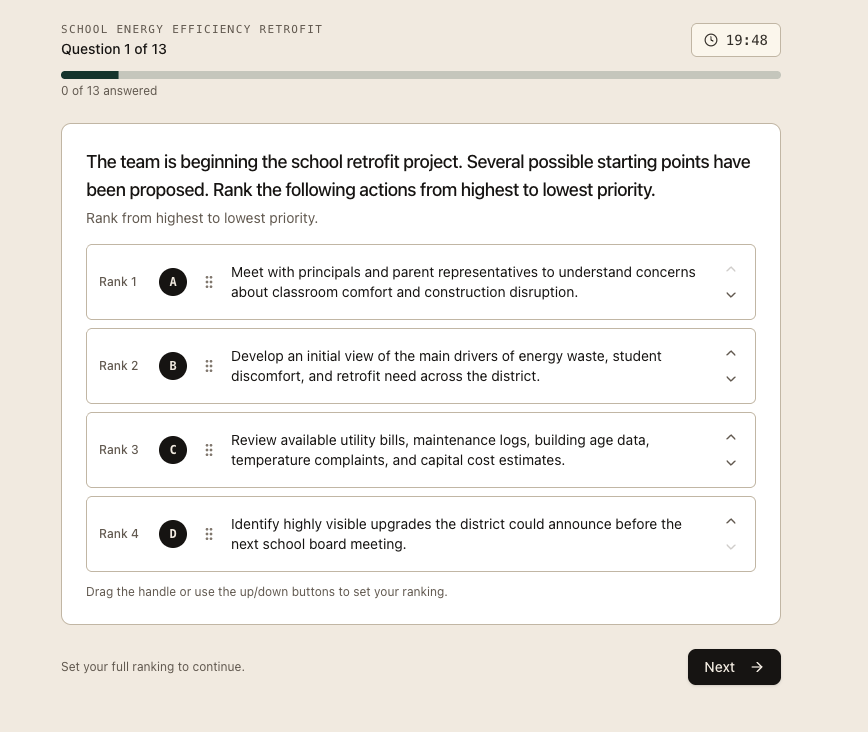 Our Sustainable Futures Lab practice — question 1 is a drag-and-drop ranking task
See question type 1 below for a full wetland example and model ranking.
The remaining questions: 12 scenario-based decisions
After the ranking question, the rest of the module appears to use multiple-choice scenario questions.
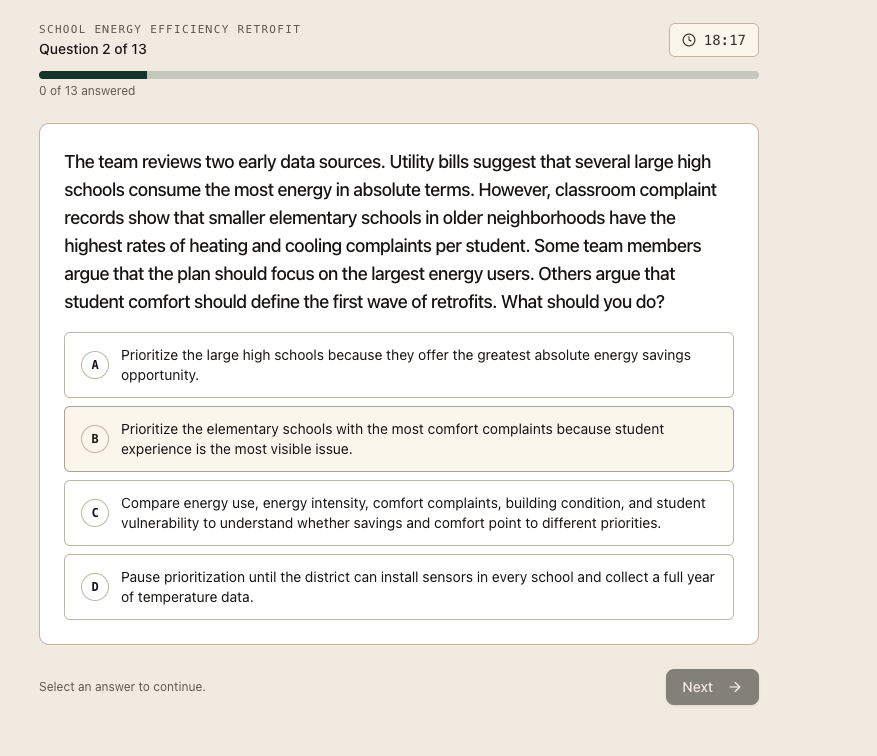 Our Sustainable Futures Lab practice — questions 2–13 are scenario-based multiple choice
Each question presents a realistic project situation and asks what you would do next. The answer options are usually all plausible. This is what makes the module tricky.
You are rarely choosing between an obviously good answer and an obviously bad answer. More often, you are choosing between answers that differ in judgment.
For example, one option may be too cautious, another may be too reactive, another may be too narrow, and one may strike the right balance.
Strong answers tend to look like sensible junior-consultant behaviour:
- keep the project moving
- stay structured
- use data, but do not overanalyze
- communicate uncertainty clearly
- involve the right people
- avoid overreacting to one new fact
- avoid forcing a simple answer when the problem is genuinely complex
Five traits Sustainable Futures Lab appears to test
Sustainable Futures Lab appears to evaluate five core traits.
1. Prioritization
Prioritization is about focusing on what matters most and sequence work effectively.
| Do (strong answer) | Don't (weak answer) |
|---|---|
| Start from the project objective | Try to analyze everything at once |
| Focus on the most material drivers | Spend time on low-priority details |
| Skip low-impact analysis | Gather data without a clear hypothesis |
| Put effort where it can change the recommendation | Confuse activity with progress |
2. Decision-making under uncertainty
Decision-making under uncertainty is about moving forward when information is incomplete.
| Do (strong answer) | Don't (weak answer) |
|---|---|
| Update your thinking when new evidence appears | Ignore new evidence because the plan is already set |
| Test uncertain evidence before fully pivoting | Immediately change direction based on one datapoint |
| Keep moving: don't freeze until everything is perfect | Wait for perfect certainty before acting |
| Stay calibrated: don't overreact to one unvalidated input | Lock in a final recommendation before the evidence supports it |
3. Interpreting messy information
Interpreting messy information means extracting meaning from incomplete, conflicting, or imperfect data.
| Do (strong answer) | Don't (weak answer) |
|---|---|
| Identify where datasets agree | Rely on only the cleanest dataset |
| Investigate discrepancies that could change the recommendation | Ignore conflicting data |
| Distinguish real differences from measurement noise | Reconcile every discrepancy regardless of materiality |
| Use representative analysis instead of analyzing everything | Present raw ambiguity without forming a point of view |
4. Balancing trade-offs
Balancing trade-offs means handling situations where multiple valid priorities exist.
| Do (strong answer) | Don't (weak answer) |
|---|---|
| Compare competing objectives explicitly | Pick one objective without enough evidence |
| Explain how different definitions of success lead to different priorities | Ignore valid stakeholder or technical concerns |
| Acknowledge when no option is obviously right | Force a single narrative too early |
| Structure the trade-off so the team can decide | Avoid deciding because the trade-off is uncomfortable |
5. Team and stakeholder effectiveness
Team and stakeholder effectiveness is about working with others under pressure.
| Do (strong answer) | Don't (weak answer) |
|---|---|
| Invite overlooked expertise into the discussion | Let the loudest or easiest-to-analyze view dominate |
| Create psychological safety | Avoid stakeholder communication until everything is finished |
| Communicate partial findings with caveats | Share a recommendation too early |
| Influence without trying to control everything | Let stakeholders interpret messy information themselves |
| Keep stakeholders informed without overcommitting | Ignore team members who raise relevant concerns |
Sustainable Futures Lab question types
After the opening ranking question, the other 12 questions are multiple-choice scenarios that follow one project storyline. The scenarios change, but the question types repeat.
Use the table below as a map, then read the walkthrough for each type.
| # | Question type | What you are deciding | Main trait |
|---|---|---|---|
| 1 | Initial prioritization | What to do first | Prioritization |
| 2 | New conflicting data | How to respond to new evidence | Decision-making under uncertainty |
| 3 | Granularity / depth | How deep to analyse | Interpreting messy information |
| 4 | Material discrepancies | Which data conflicts matter | Interpreting messy information |
| 5 | Team dynamics | How to handle team imbalance | Team and stakeholder effectiveness |
| 6 | Definition of success | What success means | Balancing trade-offs |
| 7 | Problem structuring | How to structure the problem | Balancing trade-offs |
| 8 | Stakeholder communication | What to tell stakeholders mid-project | Team and stakeholder effectiveness |
| 9 | Scope control | Whether to expand scope at the end | Prioritization |
| 10 | Final synthesis | How to present a complex conclusion | Balancing trade-offs |
Each walkthrough uses the same layout: scenario → question → answer → what to avoid.
1. Initial prioritization questions
Main trait: Prioritization · Decision: What to do first
These questions usually appear at the start of the scenario.
You are asked to rank several possible actions from highest to lowest priority. This tests whether you can structure the work before jumping into analysis.
Scenario
Your team is starting a wetland restoration project. Some team members want to review historical water-level data first. Others want to align on assumptions about water, vegetation, and bird populations. A few suggest speaking to local stakeholders about flooding concerns.
Question
Rank the following actions from highest to lowest priority:
- Gather stakeholder views on flooding risks.
- Align on assumptions about water, vegetation, and bird populations.
- Review historical water-level data.
- Develop an initial hypothesis on the main drivers of ecosystem decline.
Answer
A strong ranking would usually be:
- Develop an initial hypothesis on the main drivers of ecosystem decline.
- Review historical water-level data.
- Align on assumptions about water, vegetation, and bird populations.
- Gather stakeholder views on flooding risks.
Why
This is a hypothesis-driven approach. You first create a direction for the analysis, then use data to test it, then refine assumptions, then bring in stakeholder perspectives.
Stakeholders matter, but if you start with stakeholder input before you have a clear view of the problem, you risk collecting opinions without a structure.
Common trap
The common mistake is to start by collecting all available information. That feels safe, but it is not how a strong consulting team works under time pressure. First structure the problem, then collect the data that matters.
2. New conflicting data questions
Main trait: Decision-making under uncertainty · Decision: How to respond to new evidence
These questions introduce new evidence that challenges the team’s current view.
They test whether you can update your thinking without overreacting.
Scenario
The team receives a new dataset suggesting that insect populations may be declining independently of vegetation changes. However, the dataset covers only a short time period and uses a different methodology from the rest of the team’s data.
Some team members want to shift the project focus immediately. Others think the dataset is too uncertain to use.
Question
What should you do?
A) Ignore the new dataset until it has been fully validated against the team’s existing methodology.
B) Immediately shift the project focus to insect population decline, since new evidence should take priority over the current plan.
C) Step back and reassess the relative importance of all identified drivers, weighing the new information against existing evidence before changing direction.
D) Pause all other analysis until the team completes a full methodological review of the new dataset.
Answer
Correct answer: C
Why
C works because you take the new data seriously without letting one uncertain source reset the whole project.
What to avoid
| Option | Problem |
|---|---|
| A | Too rigid. Uncertain data can still contain useful signals |
| B | Too reactive. One unvalidated dataset should not drive a full pivot |
| D | Too slow. Deep methodology review before any team discussion wastes time under deadline |
3. Granularity and depth questions
Main trait: Interpreting messy information · Decision: How deep to analyse
These questions ask how much analysis is enough.
They usually test whether you can balance analytical depth with practical time constraints.
Scenario
The team has been using aggregate wetland data. This gives a clear overall picture, but early signs suggest that the relationship between water levels and vegetation recovery varies by zone.
Analyzing every zone in detail would improve precision but would take a lot of time.
Question
What should you do?
Answer
Analyze a small number of representative zones to test whether the variation meaningfully changes the team’s understanding.
Why
You go deeper where it could change the conclusion, without analysing every zone.
What to avoid
| Avoid | Why |
|---|---|
| Keep only aggregate data | Misses variation that could change the conclusion |
| Analyse every zone in detail | Wastes time unless every zone is decision-critical |
4. Material discrepancy questions
Main trait: Interpreting messy information · Decision: Which data conflicts matter
These questions involve multiple datasets that broadly point in the same direction but differ in details.
They test how you deal with messy information.
Scenario
The team has data on water levels, vegetation coverage, and bird populations. All datasets suggest ecological decline, but they differ in magnitude, timing, and geographic pattern. Some differences may come from measurement methods; others may reflect real zone-level variation.
Question
What should you do?
Answer
Conduct targeted reconciliation on the most material discrepancies, focusing on differences that are likely to change the team’s conclusions.
Why
This is the consulting answer: do not reconcile everything, reconcile what matters.
You need enough rigor to avoid oversimplifying the problem, but not so much analysis that the team loses momentum.
What to avoid
| Avoid | Why |
|---|---|
| Use only the cleanest dataset | Overweights one source |
| Only report conclusions that match across datasets | Hides real differences |
| Present raw datasets without a view | Pushes interpretation onto stakeholders |
5. Team dynamics questions
Main trait: Team and stakeholder effectiveness · Decision: How to handle team imbalance
These questions test how you behave when the team discussion becomes unbalanced.
They usually involve an ignored expert, a quiet team member, or a disagreement that has not been properly explored.
Scenario
The team is focusing heavily on water levels because that data is clearer and easier to interpret. However, a team member with ecological expertise raises a concern that soil quality may also be limiting vegetation recovery in some areas. The discussion continues without engaging with their point.
Question
What should you do?
Answer
Invite the team member to expand on their perspective and encourage the team to assess whether soil quality is being underweighted.
Why
This is not just about being inclusive. It is also analytically useful.
The team may be over-focusing on the clearest data simply because it is easier to analyze. A strong consultant surfaces relevant expertise and checks whether it changes the problem structure.
What to avoid
| Avoid | Why |
|---|---|
| Let the discussion continue without engaging the expert | Too passive when a material concern is raised |
6. Definition of success questions
Main trait: Balancing trade-offs · Decision: What success means
These questions ask what the team should optimize for.
They usually test trade-off thinking.
Scenario
The team needs to define what “ecosystem recovery” means. One view is to maximize total vegetation growth across the wetland. Another view is to prioritize zones that are critical for bird breeding and migration.
The team does not have enough time to explore both approaches in full depth.
Question
What should you do?
Answer
Examine both perspectives at a high level, then prioritize deeper analysis where it appears most decision-relevant.
Why
Both definitions could be valid. Vegetation growth matters, but bird habitat may also be central to the mission.
A strong answer does not pick one objective prematurely. It compares the implications of each definition and then focuses deeper work where it can change the recommendation.
What to avoid
| Avoid | Why |
|---|---|
| Focus only on vegetation growth | Picks one objective too early |
| Focus only on bird habitat | Picks one objective too early |
| Wait until both are fully explored | Too slow under time pressure |
7. Problem-structuring questions
Main trait: Balancing trade-offs · Decision: How to structure the problem
These questions test whether you can adapt the structure of the analysis to the facts.
They often appear when the problem is heterogeneous: different drivers matter in different places or under different definitions of success.
Scenario
The analysis shows that water levels appear to drive vegetation recovery in some zones, while soil quality plays a larger role in others.
The team needs to decide how to structure its understanding of the problem.
Answer
Structure the analysis to reflect differences across zones, allowing the dominant driver to vary depending on local conditions.
Why
This avoids forcing a false single answer.
In consulting, clarity is important, but clarity does not mean oversimplification. If the evidence shows that different drivers matter in different zones, the structure should reflect that.
What to avoid
| Avoid | Why |
|---|---|
| Force one driver across the whole wetland | Oversimplifies heterogeneous evidence |
| Keep analysing without a structure | Delays a framework you already have enough to build |
8. Stakeholder communication questions
Main trait: Team and stakeholder effectiveness · Decision: What to tell stakeholders mid-project
These questions test whether you can communicate uncertainty without either overcommitting or hiding.
Scenario
A local authority asks whether the team can already share a clear recommendation. The team has identified several patterns, but some relationships between water levels, vegetation, and species recovery are still being refined.
Question
What should you do?
Answer
Provide a structured update outlining key insights so far, highlighting areas of confidence and remaining uncertainty, without committing to a final recommendation.
Why
This is one of the most important SFL patterns.
A weak candidate may think the safest option is to say nothing until the analysis is complete. But consultants often need to communicate partial insights. The key is to separate what you know from what you are still testing.
What to avoid
| Avoid | Why |
|---|---|
| Share a final recommendation too early | Overcommits before analysis is ready |
| Share nothing until analysis is complete | Too cautious for a client update |
| Rush remaining analysis to force a final answer | Creates pressure without improving quality |
9. Scope-control questions
Main trait: Prioritization · Decision: Whether to expand scope at the end
These questions appear near the end of a project.
They ask whether to add extra work, keep strictly to scope, or selectively expand the output.
Scenario
As the team nears the end of the analysis, one team member suggests highlighting a few unanswered questions that could guide future ecosystem management. Others say this goes beyond the original scope and may distract from finalizing the core output.
Question
What should you do?
Answer
Identify a small number of unresolved questions that are most relevant for future decision-making, and briefly outline what additional information would help address them.
Why
This is selective scope expansion.
You are not opening a whole new workstream, but you are also not rigidly ignoring something useful. If a small addition improves the client’s decision-making, it can be worth including.
What to avoid
| Avoid | Why |
|---|---|
| Stick rigidly to original scope | May miss a small, useful addition |
| Expand into a full future research agenda | Uncontrolled scope creep |
10. Final synthesis questions
Main trait: Balancing trade-offs · Decision: How to present a complex conclusion
These questions ask how the team should present the final answer when the situation is complex.
They test whether you can be clear without oversimplifying.
Scenario
At the end of the project, it is clear that no single factor fully explains ecosystem decline. Different drivers matter in different zones, and their importance depends on how recovery is defined.
How should the team present its final conclusions?
Answer
Present a structured set of insights that shows how the team’s understanding evolved, clearly outlining the different drivers and the trade-offs between them.
Why
You acknowledge complexity without hiding behind it.
It gives stakeholders a structured view, but it does not pretend that the answer is simpler than it is. That is often what McKinsey-style judgment looks like: not “one clean answer at all costs,” but a clear synthesis of the actual trade-offs.
What to avoid
| Avoid | Why |
|---|---|
| Collapse everything into one headline conclusion | Oversimplifies real trade-offs |
| Report only the cleanest, most consistent findings | Ignores important but messier evidence |
How to answer Sustainable Futures Lab questions
The best way to approach SFL is to look for the answer that is structured, proportionate, and keeps the work moving.
A useful default:
Pick the answer that keeps the project moving without sacrificing analytical quality or stakeholder trust.
Concretely:
1. Start from the objective
Before choosing an answer, ask: what is the team trying to achieve?
Do not optimize for being nice, being fast, or doing more analysis in isolation. Optimize for the project objective.
2. Focus on materiality
Ask: would this action change the final recommendation?
If not, it is probably not the best use of time.
This is especially important in questions about messy data, additional analysis, or unresolved questions.
3. Do not overreact to new information
New information matters, but not all new information deserves a full pivot.
The strongest answer usually tests the new information against the existing hypothesis before changing direction.
4. Do not wait for perfect certainty
Consulting projects rarely have perfect certainty.
If an answer says, “wait until everything is fully complete before communicating or deciding,” be careful. That is often too passive.
5. Communicate uncertainty clearly
If the team has partial findings, the right move is often to share:
- what is known
- what is still uncertain
- where confidence is high
- what the team is still testing
This is different from pretending to have a final answer.
6. Include the right people
If someone raises a technically relevant concern, do not ignore it.
Strong answers often create space for the relevant expert or stakeholder, while still checking whether their point materially changes the analysis.
7. Avoid extreme answers
In SFL, extreme answers are often wrong.
Be careful with answers that:
- immediately pivot the whole project
- ignore new evidence
- analyze everything
- share a final recommendation too early
- refuse to share anything until the end
- force one simple conclusion when the facts are mixed
The best answer is rarely the mushy middle option. It is the one that is structured and proportionate.
Sample Sustainable Futures Lab scenario
Imagine the team is working on a wetland restoration project.
The wetland has experienced declining ecological health. Water levels are unstable, native vegetation is falling, and migratory bird populations have dropped. Early evidence suggests that restoring water balance could help vegetation recover, but the relationship is not consistent across all zones. Local stakeholders are also worried that increasing water levels too aggressively could increase flooding risk.
The team’s mission is to develop a recovery approach that improves ecosystem health while adapting as new information becomes available.
Example question
The team receives a new dataset suggesting that insect populations may be declining independently of vegetation changes. However, the dataset is based on a short observation period and uses a different methodology from the team’s existing data.
Some team members want to shift focus immediately. Others think the dataset is too uncertain.
What should you do?
A) Ignore the new data until it is fully validated.
B) Immediately shift the team’s focus to insect populations.
C) Consider the new dataset alongside existing evidence, identify what assumptions need validation, and assess whether it changes the team’s view of the main ecosystem drivers.
D) Spend a long time reviewing the methodology before discussing it with the team.
Correct answer: C
| Option | Verdict |
|---|---|
| A | Too rigid. The data may be uncertain, but it could still contain useful information |
| B | Too reactive. One uncertain dataset should not drive a full pivot |
| C | Strong. Weighs the new data against what you already know before changing direction |
| D | Too slow, especially when the project is time-constrained |
Common mistakes in Sustainable Futures Lab
Mistake 1: Treating it like a sustainability knowledge test
You do not need to know wetland science, carbon accounting, or biodiversity policy.
The environmental theme is the context. The assessment is about judgment.
Mistake 2: Always choosing the safest answer
Some candidates assume that the most cautious answer is best.
That is not true. Waiting until everything is complete can be a weak answer, especially in stakeholder communication questions.
Strong consultants communicate uncertainty clearly. They do not disappear until the work is perfect.
Mistake 3: Always choosing the most collaborative answer
Collaboration is important, but SFL is not just testing whether you are nice.
A good answer includes the right people while keeping the project structured and moving forward.
Mistake 4: Overanalyzing everything
More analysis is not always better.
The strongest answers usually focus on the analysis that is most likely to affect the final recommendation.
Mistake 5: Overreacting to new information
New data should update your thinking, not hijack it.
If one new dataset appears, the best answer is usually to test it against the current hypothesis and existing evidence.
Mistake 6: Forcing a simple answer too early
Some SFL scenarios are designed so that multiple drivers matter.
If water levels matter in one zone and soil quality matters in another, do not force one single driver just to create a cleaner storyline.
A good consultant can present complexity clearly.
Mistake 7: Refusing to share partial insights
When a stakeholder asks for an update, the answer is usually not to stay silent until the analysis is final.
A stronger answer is to share a structured interim view: key findings, confidence level, open questions, and next steps.
How to prepare for Sustainable Futures Lab
The best preparation is not memorizing answers. The scenarios can change, and the exact wording can vary.
Instead, practice recognizing the pattern behind each question.
When reading an SFL question, ask yourself:
- What is the project objective?
- What trait is this question testing?
- Is this a prioritization, uncertainty, messy-data, trade-off, stakeholder, scope, or synthesis question?
- Which answer is too passive?
- Which answer is too reactive?
- Which answer is too broad?
- Which answer keeps the project moving while preserving quality?
That is the mindset you want.
SFL rewards balanced consultant judgment: structured, practical, collaborative, and comfortable with uncertainty.
SFL test-day reminders
Always follow the instructions in your McKinsey invitation and on-screen tutorial. See also McKinsey Solve test-day rules above.
Do not use external websites, AI tools, applications, pre-prepared notes, screenshots, recordings, or outside help during the assessment unless McKinsey has explicitly approved an accommodation in writing.
This is especially important for SFL because the questions are text-based and may feel like something you could discuss or look up. Do not. Treat it like a formal assessment.
Practice Sustainable Futures Lab
The video above is a walkthrough of our Sustainable Futures Lab simulation on the platform — the same timed format you'll practice before test day.
Reading about SFL helps you understand the format. But the real challenge is making the right judgment under time pressure.
The best way to prepare is to practice full SFL-style scenarios:
- 20-minute timer
- 13 sequential questions
- first question as a ranking task
- remaining questions as scenario-based decisions
- feedback by trait
- explanations for why each answer is strong or weak
Our Sustainable Futures Lab practice is designed to help you recognize the question types, avoid common traps, and build the judgment patterns McKinsey is likely looking for.
Legacy game: Ecosystem Building
This was the classic McKinsey PSG format. It appears less common today than Redrock and Sea Wolf, but it is still useful to understand because some older guides and candidate reports refer to it.
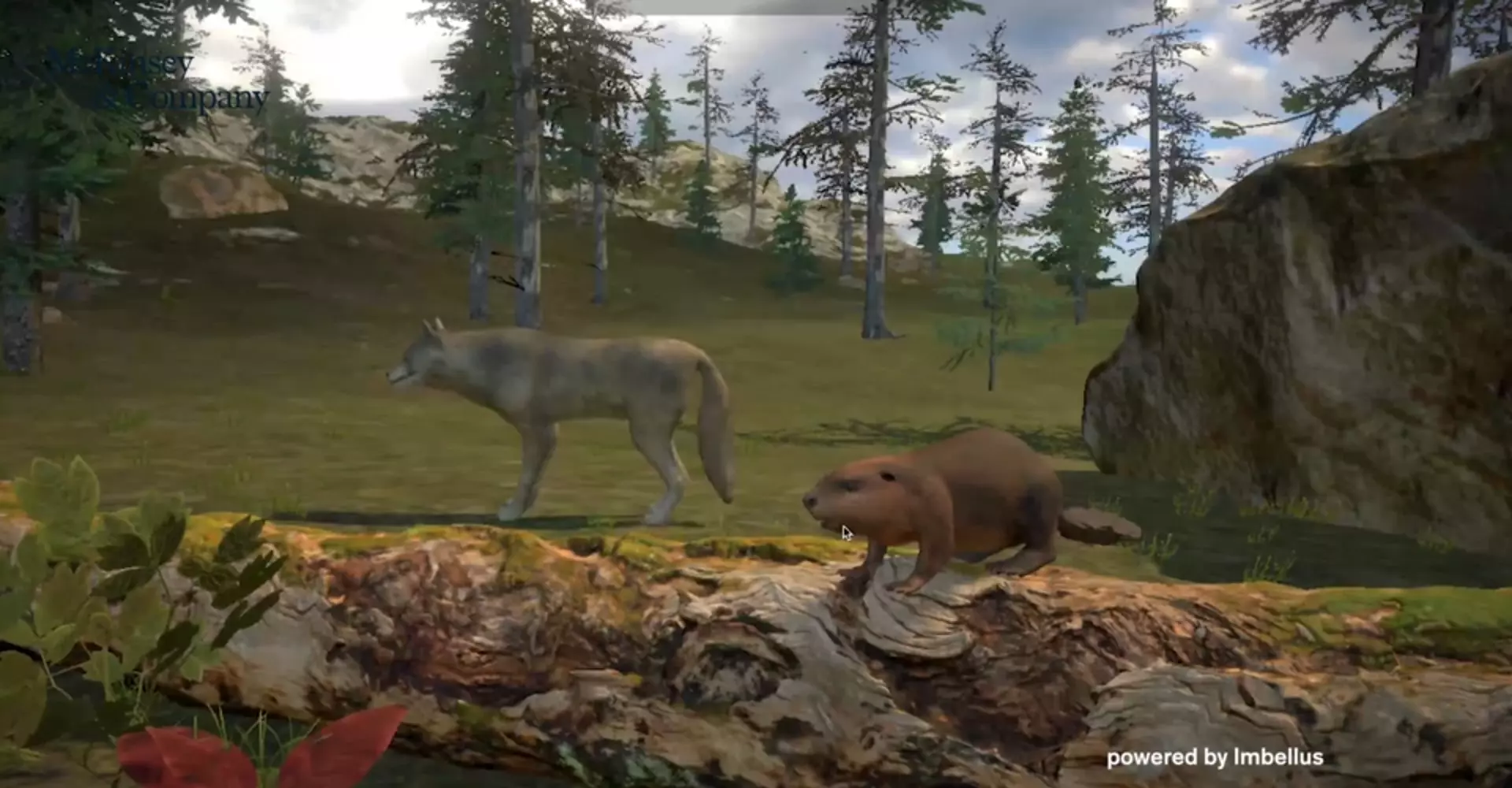
In the past some test takers were given other games as part of their Solve assessment such as the Disease and Disaster Identification game or plant defense. At the time of writing, these games are no longer part of the official assessment so ignore them if you find anything online.
Scenario and Objectives
By the way, if you would like the video guide, you can find it below!
In this scenario, you’re tasked with creating a self-sustaining ecosystem in either an aquatic, alpine, or jungle environment. Additional environments may be introduced without altering the core mechanics. We will use an aquatic (ocean) environment as an example for this article but the same advice is applicable to all other environments in the exact same way.
The enviroment will be chacterised by a number of characteristics. For the ocean, for instance, we will have:
- Depth
- Water current
- Temperature
- Salt Content
You’ll be given 39 species (both plants and animals) to choose from, each suited to specific environmental conditions, like depth and salinity in an ocean. For a mountain ridge, it could be altitude or sun exposure.
Each species has two main sets of data points:
- Environmental Suitability: Conditions like depth or temperature where they can survive.
- Nutritional Needs: The number of calories they need, which they obtain by consuming other species. Some species are producers (providing calories and consuming none) while others are animals (requiring and providing calories). For example, in an ocean setting, algae are producers and fish are animals.
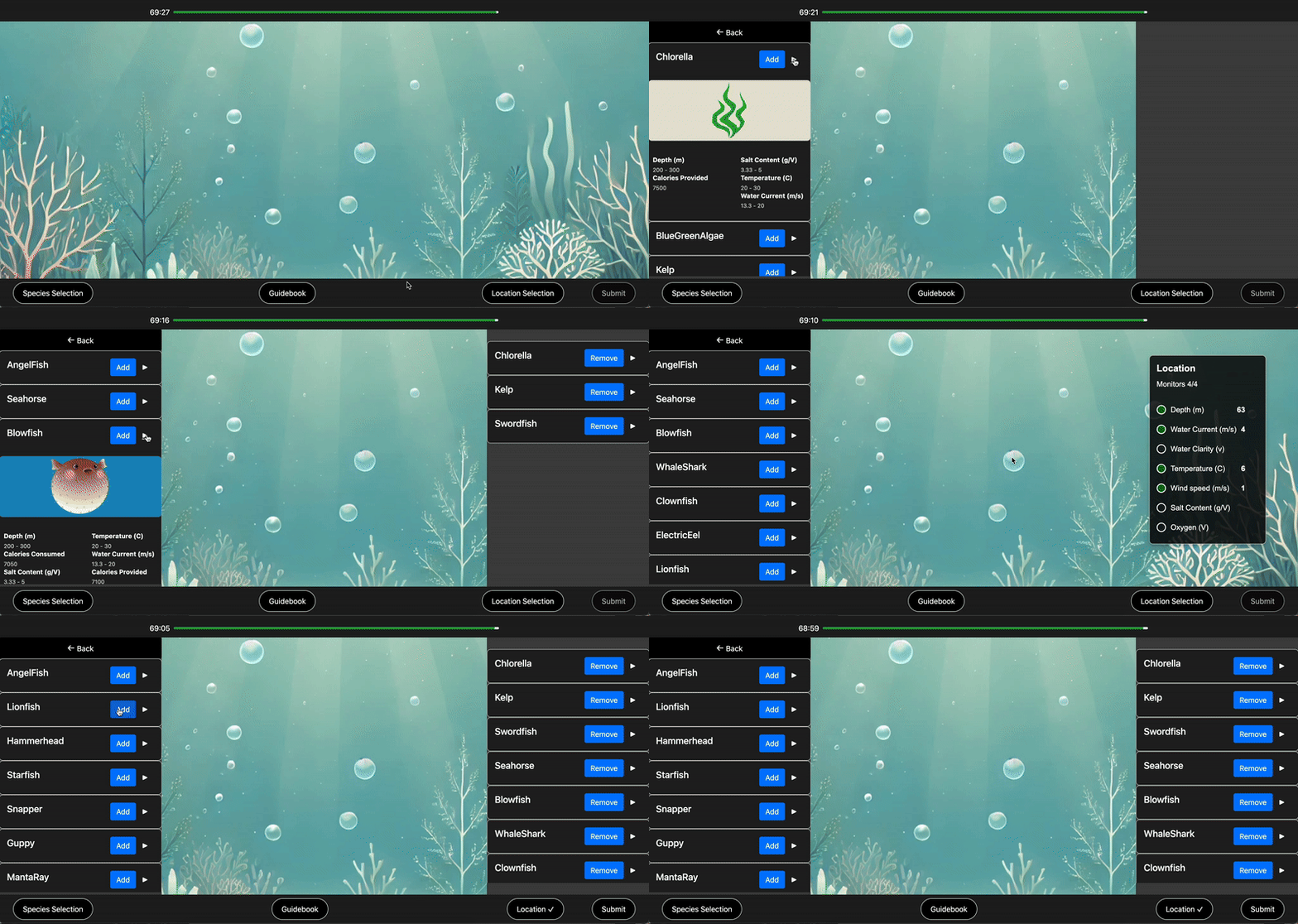
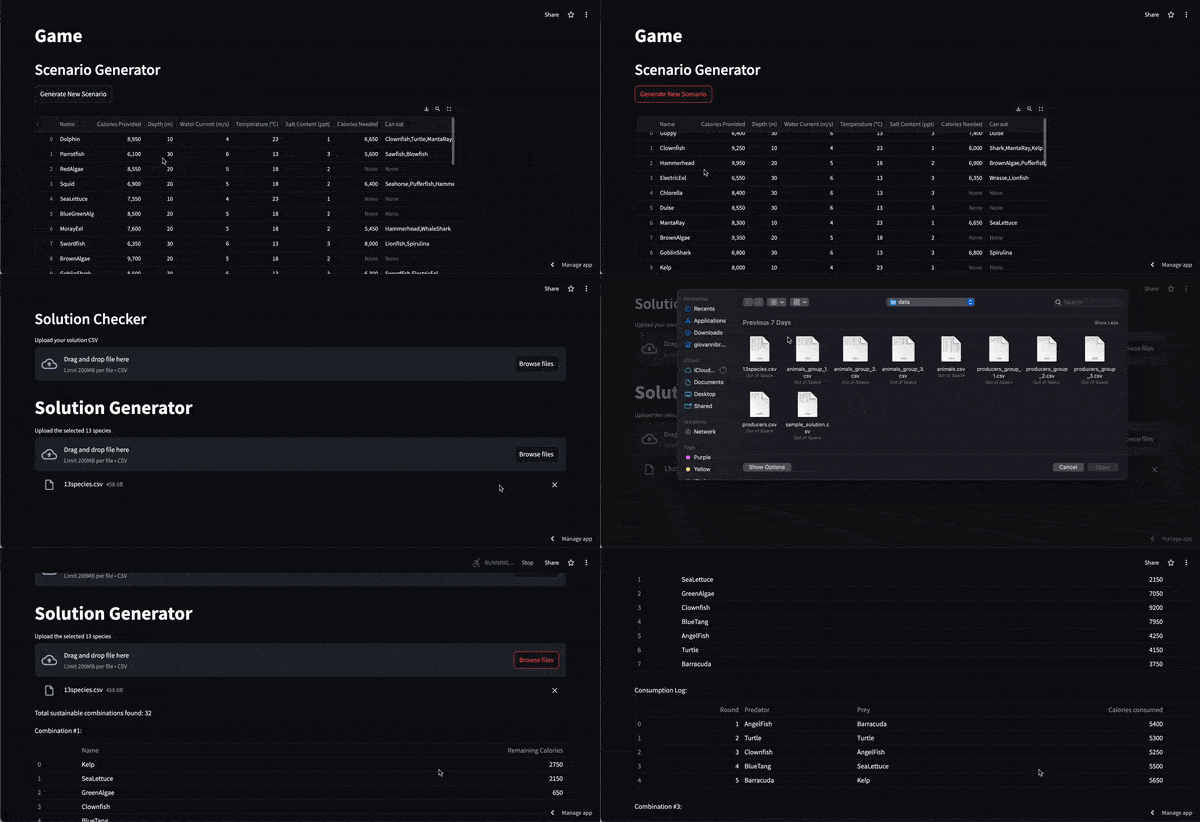
The animation above shows our simulation. On the left, you'll find producers and species with dropdowns that display their characteristics. You can add them to selected species, choose a location, and submit your choices to see if the system achieves equilibrium. Subscribe to access our full Ecosystem simulation on the platform, view plans.
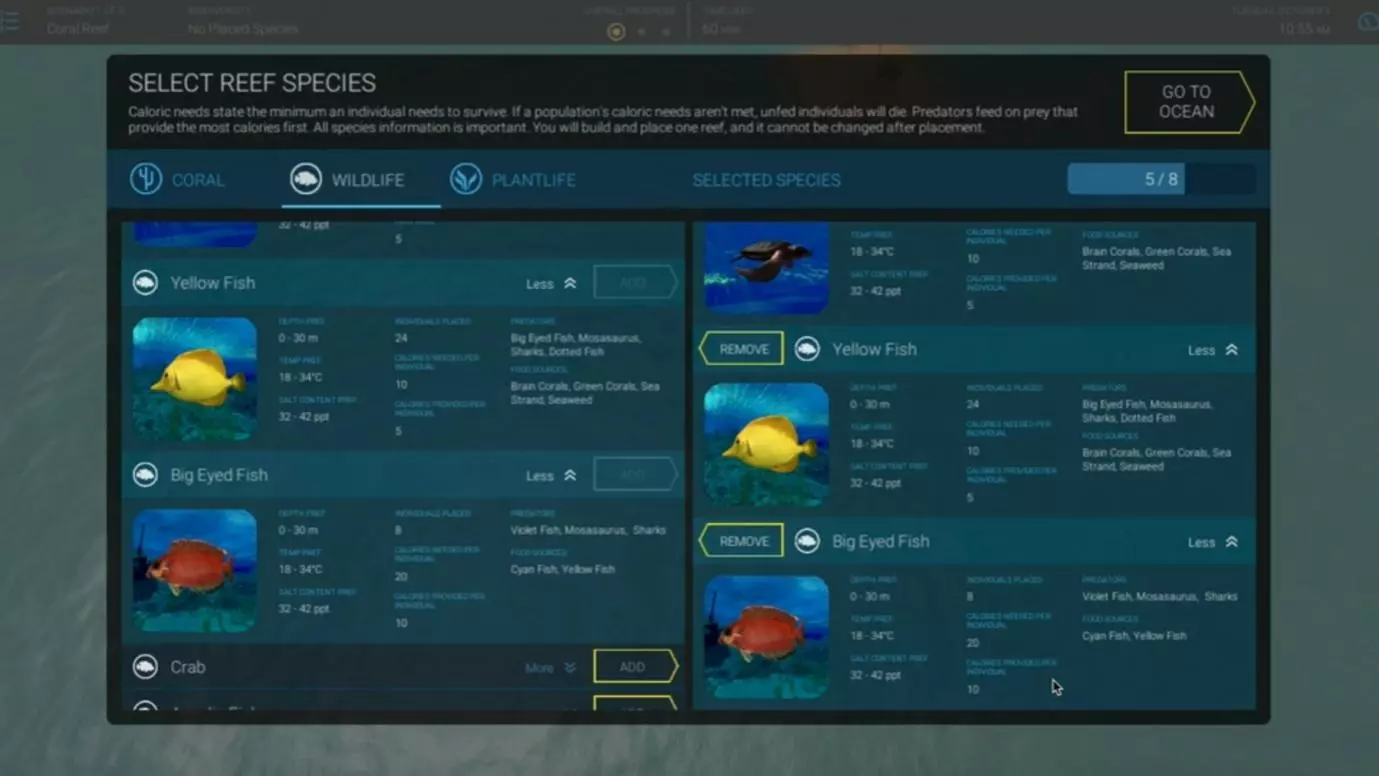
The picture above (from the actual McKinsey test) shows different fishes together with their characteristics. Each card has the following information:
-
Environmental Suitability
-
Depth: range they can live within
-
Water current: range they can live within
-
Temperature: range they can live within
-
Salt Content: range they can live within
-
Nutritional Needs
-
Calories needed: calories they need when eating
-
Calories provided: calories they provide when eaten
-
Can eat: species they can eat
-
Is eaten: species they can be eaten by. This can be inferred from other cards but we will see that it is a useful data point.
The game requires you to select a location for your ecosystem. Several different options are given, all with different prevailing conditions. You then have to select a number of different plant and animal species to populate a functioning food chain within that location.
In previous versions of the game, you would have had to fit as many different species as possible into a functioning food chain. However, newer iterations of the Solve assessment require a fixed number of eight or, possibly, seven species to be selected. The strategy for the seven species is the same as the one with eight.
Main Tasks
Let's look at the game objectives in more details
- Species Selection: Identify a set of eight (or seven) species that are in equilibrium, meaning all their caloric needs are met within the ecosystem. This means that each animal will need to have their calorie need satisfied while no animal needs to be depleted. Check the eating rules below to learn more.
- Location Selection: Choose a suitable location for your ecosystem from several options, each with distinct environmental conditions.
The former is the actual challenge while the latter is somewhat trivial. Before the strategy, here are the eating rules.
Legacy Ecosystem: eating rules and detailed strategy (click to expand)
- Species eat only once.
- If a species does not obtain the required calories or their calories are depleted, it dies.
- The species with the highest calories provided feeds first.
- A species eats the prey that provides the highest calories among available options.
- Calories consumed from prey are equal to the calories needed by the predator.
- If multiple prey provide the same amount of calories, the predator consumes an equal proportion from each.
- This process is repeated for the species with the next highest calories provided.
How to approach the game
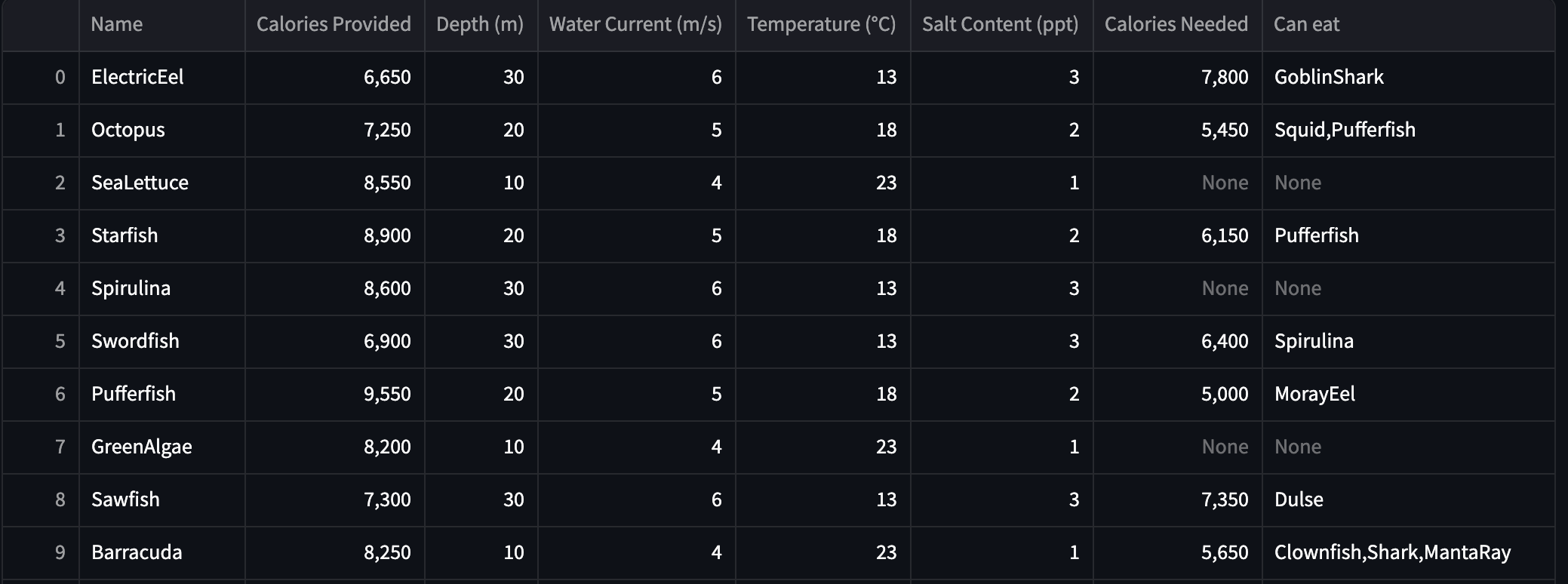
At its core, this game isn’t really a game but more of a logical puzzle administered through a more advanced User Interface (UI). The limited interactions make it a straightforward problem once you understand that the UI is not required and only adds complexity. All the essential information could be presented in a table, as shown below, and you could easily solve the puzzle on paper. The only real reason why the UI is needed is for environment selection but this is a trivial task that does not require any significant interaction with the system.
Strategy
Enough theory, let’s dive into how to solve the game. You’ll be given 39 species, grouped into three sets of 13, each sharing the same environmental constraints like depth and salinity. Each group includes three producers and ten animals.
Your first task is to pick the group most likely to produce a balanced ecosystem. To do this, quickly estimate the total calorie output for all species, check how many animals can consume the producers, and evaluate how many animals are limited to eating other animals. Use your judgment here, as these factors are equally important. Be aware that some combinations won’t lead to a solution.
Once you’ve selected your group, start building the food chain. Ideally, include all three producers (with at least one animal consuming them) as they provide calories without needing any. Then, choose animals that can:
- Eat one or more producers without depleting them
- Provide the highest calories
- Be consumed by as many other animals as possible - this is where the eaten by info becomes useful
To do this, look at the list of animals that can consume producers without depleting them (there will be one or two), then pick those with the highest calories and that can be eaten by multiple animals. You’ll find this information on the animal card.
Continue adding animals iteratively, checking your solution at every step.
If you don't manage to find a combination, move onto the next group. In order to practice and understand which groups can lead to solutions, you can use our solver.
Once you've established a balanced ecosystem, select a location where the environmental conditions meet the needs of all species. You’re likely to find such a spot. The game provides more conditions than necessary; focus only on the relevant factors mentioned in the species cards. For example, in an ocean scenario, depth and salinity might matter most, while factors like water speed can be disregarded. This is done to simulate a consulting scenario where you have more data than needed.
Once you have decided on your food chain, you simply submit it and you are moved on to the next game. In the past, test takers were apparently shown whether their solution was correct or not, but this is no longer the case.
Practice
Test takers generally report that Ecosystem Building is easier than Redrock or Sea Wolf, with process score often mattering more than speed. For legacy prep, use our Ecosystem simulation and PDF guide on the platform.
What does the Solve assessment test for?
McKinsey has been explicit on what traits the test was designed to look for. These are:
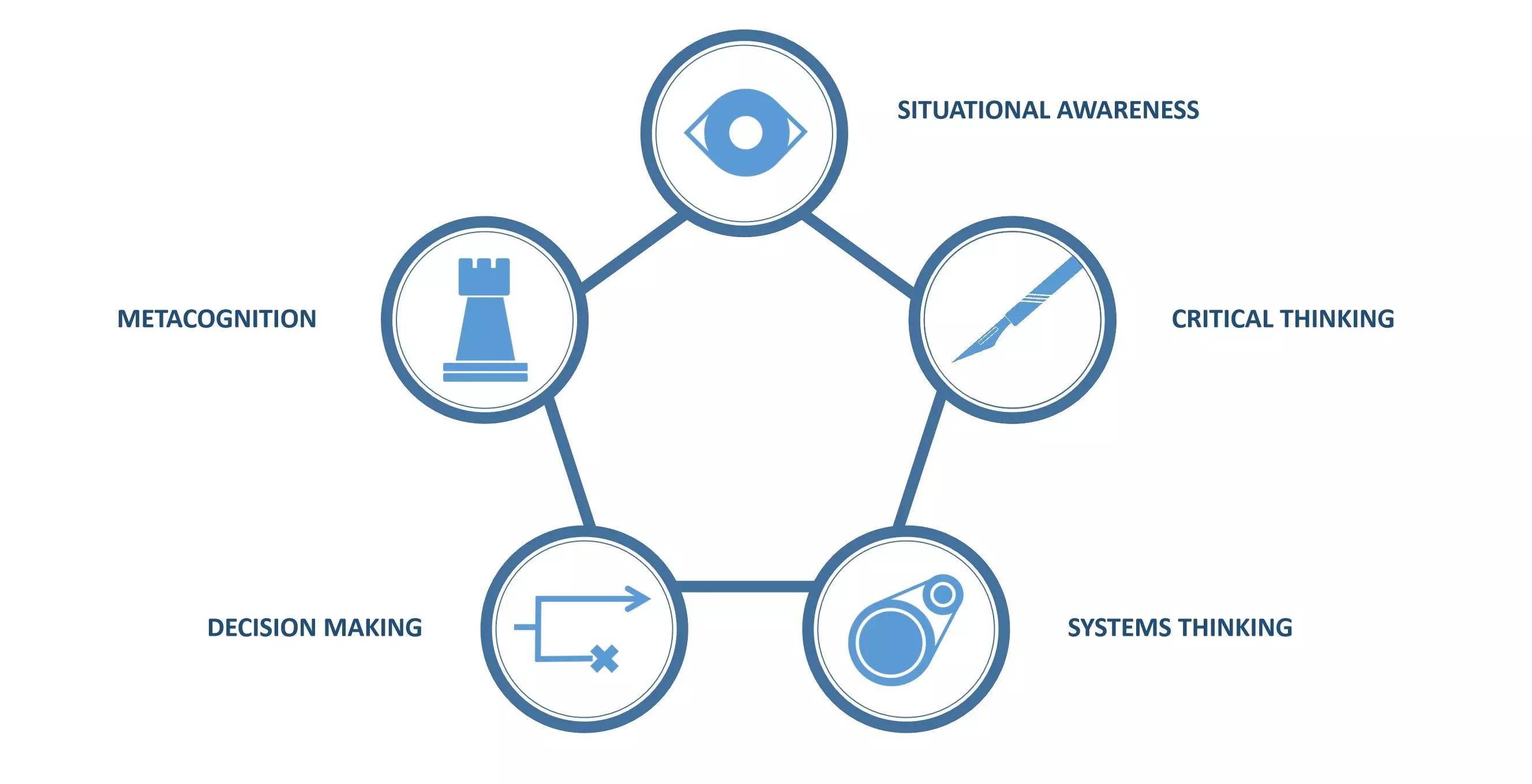
- Critical Thinking: making judgements based on the objective analysis of information
- Decision Making: choosing the best course of action, especially under time pressure or with incomplete information
- Metacognition: deploying appropriate strategies to tackle problems efficiently
- Situational Awareness: the ability to interpret and subsequently predict an environment
- Systems Thinking: understanding the complex causal relationships between the elements of a system
Equally important to understanding the raw facts of the particular skillset being sought out, though, is understanding the very idiosyncratic ways in which the Solve assessment tests for these traits.
Product and Process Scores
Perhaps the key difference between the Solve assessment and any other test you’ve taken before is Imbellus’s innovation around process scores.
When you work through each game, the software examines the solutions you generate, your product score.
But scoring does not end there. Solve also monitors how you arrived at each solution, your process score.
To make things more concrete here, if you are playing the Ecosystem Building game, you will not only be judged on whether the ecosystem you put together is self-sustaining. You will also be judged on the way you have worked in figuring out that ecosystem - presumably, on how efficient and organised you were. The program tracks all your mouse clicks and other actions and will thus be able to capture things like how you navigate around the various groups of species, how you place the different options you select, whether you change your mind before you submit the solution and so on.
You can find more detail on these advanced aspects of the Solve assessment and the innovative work behind it in the presentation by Imbellus founder Rebecca Kantar in the first section of the following video (from a few years ago):
Take your time on each action. Solve rewards deliberate, organised work more than frantic clicking.
We have some advice to help look after your process scores in our PDF Guide to the McKinsey Solve Assessment.
A Different Test for Every Candidate
Another remarkable and seriously innovative aspect of the Solve assessment is that no two candidates receive exactly the same test.
McKinsey automatically varies the parameters of their games to be different for each individual test taker, so that each will be given a meaningfully different game to everyone else’s.
Within a game, this might mean a different terrain setting, having a different number of species or different types of species to work with or more or fewer restrictions on which species will eat which others.
Consequently, even if your buddy takes the assessment for the same level role at the same office just the day before you do, whatever specific strategy they used in their games might very well not work for you.
This is an intentional feature designed to prevent test takers from sharing information with one another and thus advantaging some over others. At the extreme, this feature would also be a robust obstacle to any kind of serious cheating.
Preparation for the McKinsey Solve assessment

Can you prepare for Solve? Yes, and you should.
There’s been ongoing debate around whether preparation can meaningfully impact performance in the Solve assessment.
Especially for the legacy version, many have viewed Solve as similar to an IQ test, implying that beyond basic familiarisation to avoid test-day panic, preparation wouldn't significantly improve your score.
However, preparation is valuable for all games. Getting familiar with each game’s mechanics and logic provides a major advantage, especially under time pressure.
Preparation is not cheating. It is showing up ready for a high-stakes step.
The value of prep is even clearer with modules like Redrock (quantitative case work) and Sustainable Futures Lab (scenario judgment and trade-offs). Both reward structured thinking and deliberate pacing more than most candidates assume.
Many of your competitors will prepare seriously. A McKinsey offer is worth the effort.
How to prep

We discuss how to prep for the Solve assessment in full detail in our PDF guide.
Here are two prep paths: a free baseline and a fuller platform plan.
Step one is simply getting familiar with the games, and by reading this article, you’re already on the right track!
Free prep plan
Data interpretation practice
Redrock is the closest modern equivalent to older pen-and-paper aptitude tests. Alongside the BCG Casey assessment, it reflects a broader industry shift toward data-driven problem solving.
Use Redrock-style practice on the platform and the consulting math article to sharpen chart reading and quick calculations.
Fast Math with Calculator or Excel
Redrock involves quick calculations. While the math itself isn’t difficult, speed is critical, especially if you're using a calculator or Excel.
Check out our consulting math article for a solid introduction. For more advanced lessons and drills, explore our full math package from the Case Academy.
Master Case Studies
Redrock case studies closely resemble traditional business cases. Strong case-solving skills will directly support your Redrock performance and enhance your overall results on McKinsey Solve.
Since Solve is designed to predict case interview success, building your case skills is one of the most impactful ways to boost your score. See the final section of this article for more on case prep.
Gaming
Video games can help with assessments like Ecosystem or Sea Wolf, but much less with Redrock or Sustainable Futures Lab, where prioritization and decision structure matter more.
Despite McKinsey’s claims, many candidates report that gaming experience gives them an edge in Solve.
If you're new to gaming, even a few hours of play can help improve reaction time and pattern recognition. Games with logic, resource management, or simulation elements are especially useful.
Premium prep plan
Why choose paid prep? While free resources can be a great starting point, paid prep offers a faster, more structured, and more effective path to success. It saves time, keeps you focused, and ensures you're working with high-quality, targeted materials. And the stakes are high when it comes to a career at McKinsey.
Choose prep carefully. Quality varies a lot between providers. Look for something credible and complete.
What to look for in a prep package, and how to use it effectively. A strong prep plan should combine three core components, each serving a different purpose in your preparation:
- A strategic guide. Use this to quickly get familiar with the test format, scoring system, and core strategies. This foundation helps you approach each step with a clear game plan and avoid wasting time on trial and error.
- A solver tool to explore game mechanics. Especially for simulation-based games like Ecosystem Building, a solver tool allows you to test combinations, understand how different variables interact, and build real intuition about what works and why.
- Realistic simulations These are essential. Simulations recreate the pressure, timing, and decision-making of the actual test. Use them to refine your speed, accuracy, and confidence. Review your performance after each run to identify patterns and areas to improve.
Tip: Read the guide, try the simulations, then repeat. Improvement comes from cycling between instruction and practice.
McKinsey Solve prep on the platform
This guide explains the format. Your platform subscription is where you build speed and confidence before test day.
Our Solve prep is based on survey work and interviews with real test takers, plus follow-ups on what worked for candidates who advanced. Included with your subscription:
- Redrock, Sea Wolf, and legacy Ecosystem simulations that match the format and difficulty of the real assessment.
- A Sea Wolf solver tool that explores microbe combinations and builds intuition beyond the game interface.
- Sustainable Futures Lab practice with decision frameworks and scenario-style questions.
- A comprehensive PDF guide covering the full test.
- 100+ targeted Redrock exercises on the platform.
- BCG, Bain, and other firm screening prep so you are not buying Solve in isolation.
Does it make sense to invest in platform prep?
Yes. A McKinsey offer is worth serious prep time. One monthly subscription covers Solve simulations, case interview prep, drills, and AI case practice for the full application journey, not just one test.
How our platform prep helps you ace the test
You cannot game the system, but you can build the skills it measures. Platform prep helps you:
-
Get familiar with the test environment
Understand rules, mechanics, and pacing before test day so you can focus on problem-solving, not the interface.
-
Build the right skillset
Solve tests the same core abilities as case interviews in a more abstract format. The guide and simulators show you how to develop them step by step, using strategies that worked for past candidates.
-
Prep with purpose
Use the prep roadmap in the PDF guide to prioritise high-impact work, whether you have three days or three weeks.
Whether you are short on time or starting early, the platform is built for focused preparation: quick-start paths for busy candidates and deeper strategy for those combining Solve with case prep.
Simulations are the fastest way to improve. Jump into realistic scenarios, review what slowed you down, and build the instincts Solve rewards.
Also preparing for case interviews? Case Academy, drills, and unlimited AI case practice are included in the same subscription (no separate purchase needed).
The Next Step - Case Interviews

You’ve put in the time to craft an amazing resume and cover letter, and you've thoroughly prepared for the Solve assessment on the platform. On test day, you ace Solve and receive an invitation to a McKinsey case interview.
Now the real work begins…
While resume writing and Solve prep might have been challenging, preparing for McKinsey case interviews is even more demanding. McKinsey advises not to prepare for Solve, but they explicitly expect rigorous preparation for case interviews.
The depth of business knowledge required, along with the complexity of cases, means you’ll need to put in significant effort, learn the essentials, and practice extensively. If you’re serious about landing that McKinsey offer, you must dedicate time to mastering case studies.
Traditional framework-based approaches often fall short in dealing with McKinsey’s challenging, unique cases. At MCC, we teach a method rooted in how McKinsey trains its consultants, bypassing generic frameworks and focusing on solving cases like real consultants.
Learn more about our case-cracking method here, or dive deeper with our Case Academy course. For fit prep after Solve, see our McKinsey PEI guide. Also compare other firm tests in our BCG Casey guide and screening test prep.
McKinsey Solve FAQ
Is McKinsey Solve the same as PSG or Imbellus?
Yes. McKinsey Solve is the current name for the same online game-based screening assessment that was previously called the Problem Solving Game (PSG), Digital Assessment, or Imbellus test. The format has evolved, but these names all refer to the same broad assessment family in consulting recruiting.
What games are in McKinsey Solve in 2026?
Most candidates report Redrock, Sea Wolf, and Sustainable Futures Lab: SFL is now quite common, especially on 85-minute invitations. A 65-minute invite usually means Redrock and Sea Wolf only. Ecosystem Building is legacy.
Is Ecosystem Building still used?
It appears less common today than Redrock and Sea Wolf, but some candidates still encounter it or see it referenced in older reports. Treat it as legacy prep: useful context, not your main focus.
What is Redrock?
Redrock is a timed, case-style module with investigation, analysis, report, and mini-case sections. It tests data selection, calculations, chart choice, and structured recommendations under time pressure. Practice with our Redrock simulation.
What is Sea Wolf?
Sea Wolf (sometimes called Ocean Cleanup) is a constraint-solving module where you select groups of microbes whose averaged attributes and traits match site requirements. Practice with our Sea Wolf simulation.
What is Sustainable Futures Lab?
Sustainable Futures Lab (SFL) is a scenario-based judgment module, prioritization, trade-offs, and decision-making under ambiguity. It is now a standard part of many 2026 Solve invitations, especially 85-minute versions. Start Sustainable Futures Lab practice.
How long does McKinsey Solve take?
Check your invitation email. A 65-minute invite usually suggests Redrock and Sea Wolf only; an 85-minute invite may include Sustainable Futures Lab. Exact timing can still vary by version.
Can I use ChatGPT, websites, notes, or screenshots during Solve?
No. McKinsey requires candidates to complete Solve alone without external websites, AI tools, applications, screenshots, recordings, or pre-prepared notes unless you have a written accommodation.
Can I use a calculator or scratch paper?
Follow the instructions shown in your invitation and inside the assessment environment. Do not assume you may use external tools unless the on-screen rules explicitly allow them.
What happens if the game crashes?
Contact McKinsey support immediately if you hit a technical issue, do not wait until after you finish.
What happens after McKinsey Solve?
McKinsey reviews your Solve results together with your resume. Strong performance on both is typically needed to advance to live case interviews and PEI rounds.
Can I prepare for McKinsey Solve?
Yes. You cannot memorize exact answers because parameters vary, but you can prepare for the logic, timing, interface patterns, and calculation types, especially for Redrock and Sea Wolf.
How should I prepare if I only have 3 days?
Prioritize one Redrock run and one Sea Wolf run, review the pacing frameworks in this guide, and brush up on consulting math.
Should I prepare for case interviews before or after Solve?
Start Solve prep as soon as you apply, invitations often arrive within about a week. Case interview prep matters too, especially for Redrock, but do not delay Solve preparation until after cases.
Background: why McKinsey uses Solve
If you want the wider context (not what you need on test day), McKinsey introduced Solve to screen large applicant pools before expensive case interviews. It replaced older pen-and-paper aptitude tests that were costly to administer and easier to prepare for in a formulaic way.
Solve was developed by Imbellus (now part of Roblox) and is designed to assess thinking skills online, at scale, with parameters that vary by candidate. McKinsey’s own overview is here.