BCG Casey Guide 2026: Online Case Format, Questions and Prep
Prepare for BCG Casey with a 2026 guide to the chatbot online case — format, question types, sample answers, a mini walkthrough, and video recommendation prep.
 Robot toy head and shoulders, illustrating BCG's use of a chatbot
BCG Casey is BCG's chatbot-led online case assessment. You may also see it called the Online Case Experience (OCE) or receive the invite from HireQuotient on behalf of BCG.
It is not the CCA screening test and not an office numerical / cognitive test. It is a single business case, broken into timed questions, ending with a 60-second video recommendation.
Not sure which BCG test you have? Start with our BCG online assessment overview.
BCG Casey: quick answer
| Question | Answer |
|---|---|
| What is Casey? | BCG's chatbot online case — one business scenario, sequential questions, final video. |
| Also called | OCE, Online Case Experience, HireQuotient online case, BCG online case. |
| How long? | Roughly 30–35 minutes for the case; ~60 seconds for the final video. |
| How many questions? | Usually 8–10 (some have sub-parts). |
| Question types | MCQ, numeric input, short text, video recommendation. |
| Can you go back? | No — answers are final. |
| Calculator? | Usually yes — follow your invite. |
| vs CCA | CCA = SHL screening. Casey = full online case. |
| vs live interview | Chatbot drives the flow; no hints; higher time pressure. |
What Casey is
Casey simulates a case interview in an online, chat-style interface — similar to messaging apps, with prompts from a chatbot rather than a live interviewer.
You complete it at home on a laptop with a webcam. BCG uses it to assess case-style reasoning before or alongside live interviews, depending on the office.
The assessment is not adaptive feedback-driven chat. The bot asks standardized questions in sequence. You answer, submit, and move on.
What happens on test day
A typical Casey session looks like this:
- Intro / instructions — format rules, timing, technical checks.
- Case prompt — business problem, often with text and exhibits (charts, tables).
- Sequential questions (~8–10) — structuring, exhibits, calculations, judgment; mixed formats.
- Final video — ~60-second recommendation recorded on webcam (strict cutoff).
Question formats you will see
| Format | What you do | Casey tip |
|---|---|---|
| Multiple choice | Pick one or more options | Eliminate fast; submission is final |
| Numeric input | Enter a calculated number | Double-check setup; calculator usually allowed |
| Short text | One or two sentences | Be direct; no time for essays |
| Video | Record final recommendation | Use a fixed structure — see below |
Rules that matter:
- You cannot return to previous questions.
- You must answer to proceed — no skipping.
- Questions can have sub-parts; pace varies question to question.
- Early mistakes in math or framing can carry through the case — check work when you can.
- The chatbot gives no hints if you go off track.
What types of questions does Casey ask?
BCG does not publish a full official question bank. Based on candidate reports and BCG's online case descriptions, these are the recurring categories.
1. Structuring questions
Usually early in the case — which areas to investigate first.
Example
A retailer has experienced declining profits over the last two years.
Which areas would be most useful to investigate first?
A. Product pricing
B. Sales volume
C. Competitor activity
D. Store rent costs
E. Weather patterns
Strong picks: A, B, C, D — they cover the main profit drivers (price, volume, competition, fixed costs). E is usually a weak first cut unless the case is explicitly about weather-sensitive categories.
2. Exhibit interpretation
Read a chart or table and draw the right insight — not just restate the data.
Example
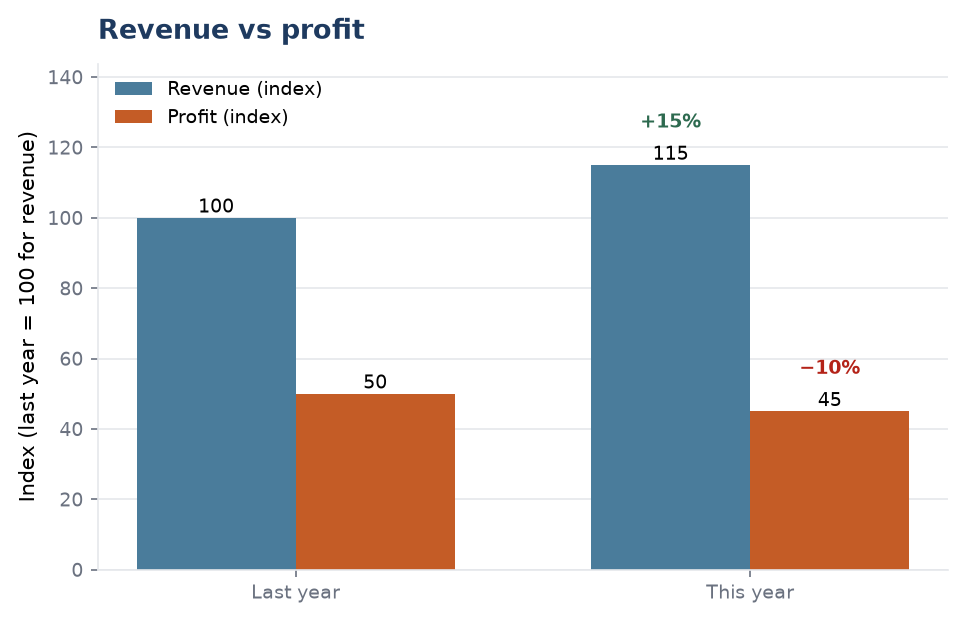 Revenue up 15% while profit falls 10% — indexed bar chart
Revenue increased by 15%, while profit declined by 10%.
What is the most likely explanation?
A. The company reduced prices, driving volume but hurting margin
B. Costs grew faster than revenue or the mix shifted to lower-margin products
C. Revenue and profit always move in opposite directions
D. The chart must contain an error
Answer: B. Revenue up and profit down means margin pressure — costs, mix, or both. A might be true but is not the only explanation; C and D are traps.
3. Quantitative questions
Multi-step business math under time pressure. Arithmetic is often easy; setup is not.
Example
Revenue is $500M. Profit margin is 20%.
What is annual profit?
A. $80M
B. $100M
C. $120M
D. $400M
Answer: B. $500M × 20% = $100M. D is revenue minus a misapplied margin.
4. Business judgment
Choose the best next step or strategic read — not the biggest market or the safest option by default.
Example
A client can enter Market A or Market B.
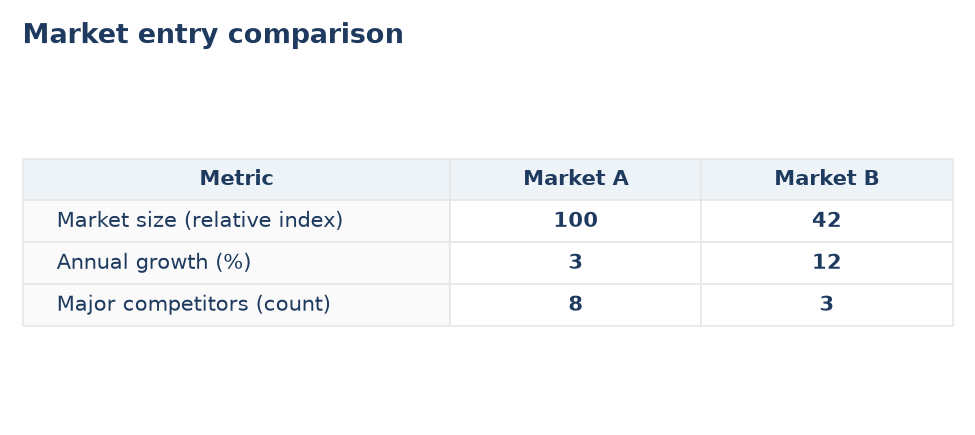 Market A vs Market B — comparison table
Market A is larger but highly competitive.
Market B is smaller but growing faster with fewer competitors.
Which market should the client investigate first?
A. Market A — larger markets are always better
B. Market B — better growth and competitive dynamics, if the client can win there
C. Both equally — no need to prioritize
D. Neither — avoid new markets in a downturn
Answer: B. Size alone is not enough. A strong Casey answer weighs growth, competition, and the client's ability to win. A ignores competitive intensity; C and D avoid a clear recommendation.
5. Recommendation questions
Synthesis at the end — often the video, not just MCQ.
Example
Should the client launch a new product in Market X?
A. Yes — list five observations from the case without a clear decision
B. Yes — market growth and fit outweigh risks; pilot first in the strongest region
C. No — any new product is too risky
D. Cannot determine — insufficient information (without using what the case gave you)
Answer: B. Lead with yes/no, then 2–3 evidence points and a risk/next step. A is observation-only; C and D are overly vague if the case provided data to decide.
Walkthrough: one Casey case from start to finish
Below is a fictional abbreviated case showing how question types chain together. Your real case will differ, but the logic is what matters.
Prompt: EcoFresh sells premium bottled water. Profit has fallen 12% despite flat volume. The CEO asks why and what to do.
Q1 — Structuring
Which areas should be investigated first?
Good focus: input costs, pricing, channel mix, fixed costs (bottling/plants).
Weak focus: unrelated macro trends with no link to profit.
Q2 — Exhibit
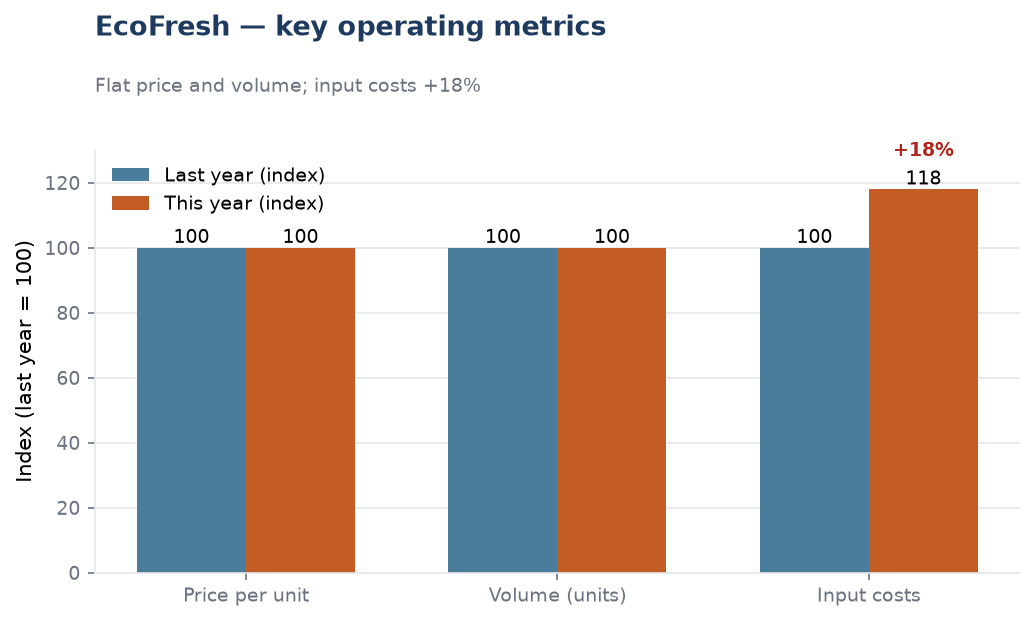 EcoFresh operating metrics — flat price and volume, input costs up 18%
Input costs +18%, price per unit flat, volume flat.
Insight: Margin compression from costs, not volume collapse.
Q3 — Quantitative
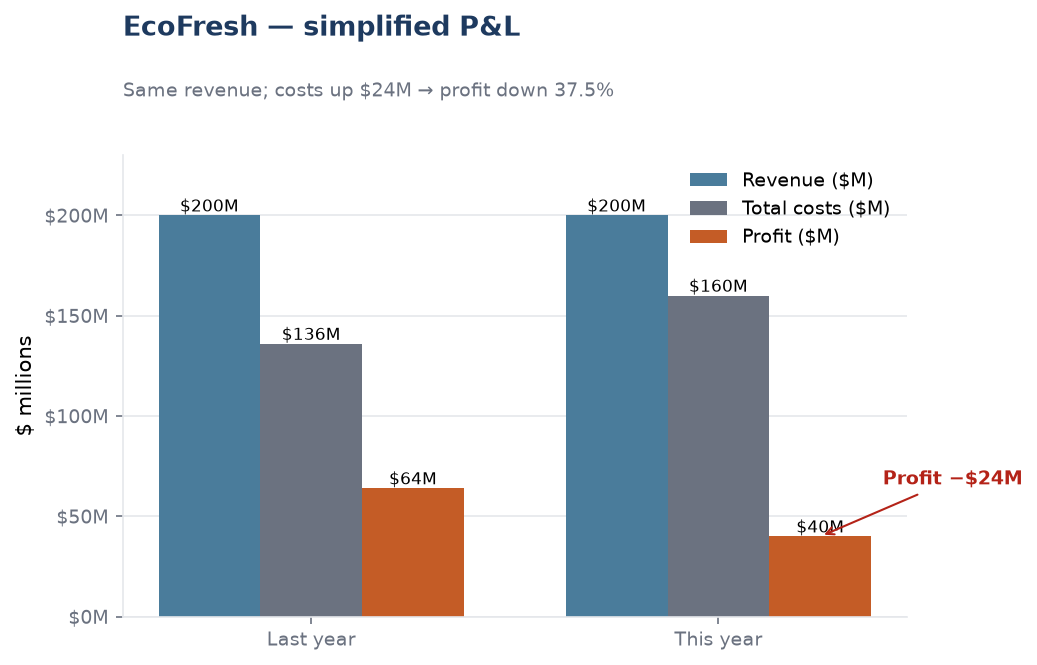 EcoFresh simplified P&L — revenue flat, costs up, profit down
Revenue $200M, costs $160M this year vs $136M last year (same revenue). What happened to profit?
Last year profit: $200M − $136M = $64M
This year profit: $200M − $160M = $40M
Profit fell by $24M (~37.5%) — aligns with the cost spike.
Q4 — Judgment
Options: (A) cut marketing, (B) renegotiate suppliers, (C) exit premium segment, (D) raise prices 8%.
Strong direction: B and/or D depending on elasticity data in the case — fix cost or price, not random cuts.
Q5 — Video recommendation
See the 60-second structure below. Example opening: "I recommend a targeted price increase and supplier renegotiation, starting with the two highest-cost SKUs."
If you mess up Q3, later numbers may be wrong — that is why accuracy on early quant matters.
Casey vs live case interviews
Many candidates prepare as if Casey were a normal interview. It is not.
| Live case interview | Casey |
|---|---|
| Human interviewer | Chatbot |
| Flexible conversation | Fixed sequence |
| Clarifying questions | Limited or none |
| Interviewer can redirect you | No feedback — self-correct fast |
| Spoken synthesis | Typed answers + 60s video |
| Mental math common | Calculator often allowed; harder setup |
The biggest adjustment: Casey controls the flow. Answer the question in front of you, use the exhibits provided, and keep moving.
Practical differences to prep for:
- More time pressure — on-screen timers; video cutoff is strict.
- No interviewer feedback — early errors compound.
- Read fast — large text blocks, not verbal prompts.
- Heavier structured math — calculator handles arithmetic; you must set up the problem.
Where Casey fits in BCG recruiting
Usage varies by office:
Casey as gatekeeper — before live interviews; may sit alongside HR screens or other tests (CCA, Pymetrics in some offices).
Casey with live interviews — same day or same round as Zoom case interviews; replaces one live case slot.
Same case for everyone? Often similar themes by region and cycle, but do not assume identical questions or copy answers from others. Parameters and details can differ.
BCG uses Casey (like other online assessments) to add a comparable data point early and reduce interview load. For context on the full BCG landscape, see the 2026 hub overview.
How to prepare for Casey
Casey prep is case prep with Casey-specific constraints — not a separate skill universe.
If you have several weeks
- Build general case skills: case interview guide, consulting math.
- Practice interviewer-led cases from the case library — closer to Casey's sequential flow.
- Run solo timed cases with a calculator; no pausing to mimic "no going back."
- Record 60-second recommendations on webcam until the structure feels automatic.
- Do zero-feedback practice — partner or solo, no mid-case hints.
If you have only a few days
Focus on the highest leverage items:
- Skim this guide and the walkthrough above.
- One or two solo timed cases with calculator + video ending.
- Refresh consulting math — percentages, margins, break-even logic.
- Test-day setup below — do not lose time to logistics.
If you already case well but have never seen Casey
You may pass on skill alone — but many strong casers fail on format: too slow on reads, no video prep, or careless early math. Do at least one timed solo run and one video rehearsal.
Test-day checklist
- Laptop + webcam — not a phone; stable Wi‑Fi; machine plugged in.
- Quiet room — no interruptions; you generally cannot pause mid-case.
- Desk setup ready before you start — paper, pen, calculator, water.
- Lighting and background — professional enough for the 60-second video.
- Dress professionally — especially for the final recording.
- Read each question first — then pull only the exhibit data you need.
The final video recommendation
The video is often the highest-stakes minute of Casey. Use a fixed structure — do not ramble through every exhibit.
Recommended 60-second structure
1. Recommendation (10s) — state the answer first.
"I recommend EcoFresh raise prices on its top two SKUs by 5–8% and renegotiate packaging contracts, rather than cutting marketing broadly."
2. First reason (20s) — strongest evidence.
"Input costs rose 18% while prices were flat, which explains most of the profit drop."
3. Second reason (20s) — supporting point.
"Volume held steady, so demand did not collapse — the issue is margin, not market share."
4. Risk and next step (10s)
"The main risk is volume sensitivity to price. I would pilot the increase in one region before rolling out nationally."
Formula: Recommendation → Reason 1 → Reason 2 → Risk / next step
Common mistakes
Treating Casey like a live interview — you do not lead; you respond to each prompt.
Over-analyzing early questions — progress beats perfection; the clock does not wait.
Reading every exhibit cell — start from the question; pull only what you need.
Freezing on calculations — set up the math, make your best attempt, move on.
Observations instead of insights — "revenue rose" is weak; "revenue rose but profit fell, so margins compressed" is strong.
Skipping video practice — candidates drill MCQs but wing the recording. Do not.
Casey FAQ
Is Casey the same as the BCG CCA?
No. CCA is an SHL screening assessment. Casey is a full online case.
If your invite says CCA, use our CCA-style practice test for reasoning and behavioral mechanics — not the Casey chatbot simulation.
Is Casey the same as HireQuotient?
HireQuotient is often the platform that delivers the case. If your invite mentions HireQuotient and describes a business case with exhibits and a recommendation, prep for Casey.
Can I use a calculator?
Usually yes for Casey — confirm in your invitation. Some other BCG tests do not allow tools.
Can I go back to change an answer?
Assume no. Treat every submission as final.
How important is the video?
Very. It is your clearest "consultant communication" signal in the assessment.