← Resources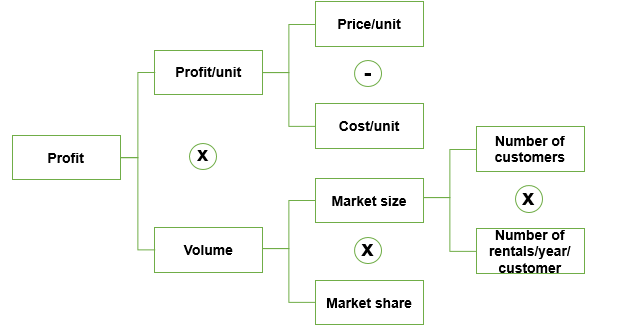
TuxedoRental.com
HardInterviewer-ledGrowth strategyMarket sizingPricing
Case exhibits
10 exhibits for this case
TuxedoRental-exhibit-1
Suggested case structure
Key question: should our client acquire TuxedoRental.com and what improvements can be made to the business?
Exhibit 1
The current and future level of profitability should be assessed. Suggested areas of focus:
- Volume:
- Market size: How big is the market for Tuxedo rental? How many customers are there in the market and how often do they rent on average?
- Penetration: What is Tuxedorental’s market share?
- Profit/unit: What are the economics for each unit? Is there a chance to increase prices?
- Lifetime value: How will the above economics change over a medium to long term period?
The above structure could also have built with the standard profitability framework, but focusing on profit/unit instead of total profit can be helpful in analyzing unit economics and identifying potential price change opportunities.
If needed share Exhibit 1 with the interviewee
1. Market sizing
How would you size the addressable market in terms of revenue potential?
Exhibit 2
Make sure the interviewee shows a similar logic when sizing the market. If interviewee gets stuck on one branch, push their thinking by asking questions. If interviewee cannot proceed, then lay out a part of the issue tree for them. Logic behind numbers: start with U.S. population (300M), cut in half for men (150M), use a reasonable assumption for the % willing to rent online (20% is ours), multiply by an assumption for rentals per year (2 is ours) to get total volume. Multiply by their price ($95) to get the total addressable market size.
Key insight
Market is large enough to be worth considering. Should proceed with evaluating the acquisition.
If needed share Exhibit 2 with the interviewee
2. Unit economics
How would you evaluate the unit economics of a tuxedo rental?
Share Exhibit 3 with the interviewee to start initial thinking on unit economics
Exhibit 3
Interviewee should begin brainstorming additional costs. Share Exhibit 4 after interviewee has successfully thought through key costs.
Exhibit 4
Make sure the interviewee acknowledges there are additional costs and suggests at least 1 of the above 3 additional costs. After giving all assumptions, ensure interviewee accurately tabulates net margin. All cost assumptions include variable and amortized fixed costs (i.e., fixed costs per rental)
Unit cost estimate: Estimate the total margin associated with one suit rental
Net margin = Gross margin – Shipping cost – Stitching/ Repairs – SG&A
Hence,
$60 - $20 - $10 - $20 = $10 (10.5% of revenue)
Key insight
Unit economics look quite poor with just a 10.5% net margin. This will be a pain point for the company.
A customer survey indicates that Tuxedo can raise prices to $110 and risk losing only 10% of customers. Should they do it?
Interviewee should be able to reproduce these tables on their own. If they need help, offer 1 assumption to push their thinking along.
Exhibit 5
If needed share Exhibit 5 with the interviewee
Unit cost estimate: Estimate the total margin associated with one suit rental
Net margin = Gross margin – Shipping cost – Stitching/ Repairs – SG&A
Hence,
$75 - $20 - $10 - $20 = $25 (23% of revenue)
Key insight
Unit economics are much improved. In order to compare apples-to-apples with prior unit economics, should take a 10% “haircut” from net margin (so $22.50 or 20.4%) to account for customer attrition. New average net margin is higher than $10 so company should move forward with price increase.
Make sure interviewee is able to accurately recalculate gross margin. If interviewee fails to take 10% haircut for attrition, ask them how they would account for attrition. Ensure interviewee acknowledges the attrition and, ideally, gets to $22.50 before moving on.
3. Customer lifetime value
How would you calculate the lifetime value of a customer?
Share Exhibit 6 with the interviewee to start initial thinking on Lifetime Value (LTV)
Exhibit 6
If interviewee asks about customer acquisition cost (CAC), offer Exhibit 7. If not, push interviewee to think about costs and offer the number if they are unable to proceed.
Exhibit 7
If needed, share with the interviewee the below definitions:
Customer lifetime value : Estimate the total revenue a customer brings in over their lifetime
Churn rate: The percent of customers who stop using the business each year.
Customer Lifetime Value (LTV)= Annual revenue / Annual churn rate
By dividing annual revenue by the churn rate, you are calculating the stream of revenues that will come from a single customer (each subsequent year will deliver, on average, 40% of the revenue of the prior year until it gets to zero).
Hence,
Customer LTV = ($10 * 2) / 40% = $20 / 40% = $50
Key insight
Though customer lifetime value is positive, it is less than CAC so Tuxedo is losing money on every customer
Ensure the interviewee accurately calculates LTV, acknowledges additional costs and once given CAC, is able to calculate compare to LTV. Interviewee may get stuck analysing churn rate and if so, ask them to conceptually walk you through how they’d consider churn. If answer is satisfactory, provide them with the LTV formula.
If Tuxedo can raise the price to $110, how does that change LTV?
Interviewee should be able to reproduce these tables on their own. If they need help, offer 1 assumption to push their thinking along. Margin starts at $25, as we saw in question 3B.
Exhibit 8
Customer LTV = Annual revenue / Annual churn rate
By dividing annual revenue by the churn rate, you are calculating the stream of revenues that will come from a single customer (each subsequent year will deliver, on average, 40% of the revenue of the prior year until it gets to zero).
Hence,
Customer LTV = ($25 * 2) / 40% = $50 / 40% = $125
Key insight
Customer LTV is now positive and greater than CAC meaning Tuxedo is making money on every customer!
Ensure the interviewee accurately calculates LTV, acknowledges additional costs and once given CAC, is able to calculate compare to LTV. Interviewee may get stuck analysing churn rate and if so, ask them to conceptually walk you through how they’d consider churn. If answer is satisfactory, provide them with the LTV formula.
If needed share Exhibit 8 with the interviewee
4. Revenue growth opportunity analysis
Suppose Tuxedo has the opportunity to partner with a famous designer. What would you consider in evaluating this partnership?
Exhibit 9
Suggested areas of focus:
- Volume:
- New customers- will this partnership tap into a new demographic of customers or convince customers who are “on the fence”?
- Existing customers- with this partnership increase occasions among existing customers?
- Price: Does this partnership increase the price we can charge for rentals? Is the designer popular with our target customer?
- Cost: What are the costs of this partnership? Will this cut into our already thin margins?
Make sure the interviewee builds a logical structure that includes some thought around incremental volume, incremental price charges and incremental costs. We are examining the incremental impact of this partnership because we want to know what it will bring over-and-above what we could have done ourselves.
If needed share Exhibit 9 with the interviewee
5. Ecommerce funnel
In examining the business, you are asked to evaluate the ecommerce funnel. If 100 emails are sent, how many customers ultimately transact?
Share Exhibit 10 with the interviewee and ask for the number of customers who transact
Exhibit 10
Transaction count: The number of customers in the funnel who ultimately transact
# of customers who ultimately transact: 100 * % open rate * % CTO * % add-to-cart * (1- % cart abandon)
Hence,
# of customers who ultimately transact: 100 * 25% * 80% * 50% * (1- 90%) = 1 customer
This formula calculates the number of people moving through the funnel from step-to-step.
Key insight
1% conversion rate is low. Key issue is in the cart abandon stage.
Interviewee needs to be able to develop logic to calculate conversion rate and acknowledge it is low. Bonus if interviewee offers recommendations for how to solve cart abandons (trigger emails, optimize XO).
6. Executive summary
Imagine you run into the lead client in the elevator and she asks for an update. What will you tell her about the team’s findings?
Sample points to share with client:
- Yes, you should acquire Tuxedo at a low bid and make some easy improvements to the business.
- As we evaluated the Tuxedo acquisition, we looked at many angles, including customer, company and competition (include detail behind each)
- In evaluating the market size, we estimated a $5.7B market which shows high potential
- Looking at current unit economics, net margin is quite low at $10 but there is an opportunity to increase this to $30 with minimal loss of customer interest
- Currently, acquisition costs outsize lifetime value so a price increase will be necessary to make the business profitable
- As we examine the eCommerce funnel, there is significant opportunity at checkout, as cart abandonment rate is 90%, leading to just a 1% conversion rate
Interviewee should summarize each of the questions that you’ve gone through and share recommendations for improvement. Interviewee should lead with a recommendation on what the client should do and if the interviewee touches on next steps, this is a stellar answer.