Supercrops
Case exhibits
3 exhibits for this case
Supercrops-exhibit-1
Exhibit 1
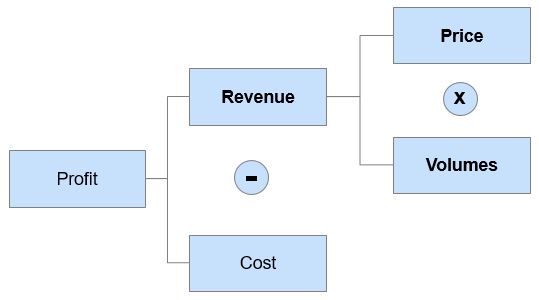
- Volumes: Understand whether the market size is large enough to justify the product launch. If there’s no market, no point in launching the product.
- Price: Identify the right pricing point based on:
- Availability of similar products on the market
- [If similar products are not available in the market] Value (incremental profit) generated for customers
- Profitability
- Cost base: Check that cost base ensures profitability at the optimal price level
- Estimate potential profit
1. Volumes
The interviewee should enquire about the revenue generated by growing strawberries in the US.
Exhibit 2
Market size estimate: The total revenue generated by growing strawberries in the US is given by

Hence,
36,000$∗(45∗2,000)=3.24 𝐵𝑛$
Key insight
The market size looks large enough to continue the analysis.
2. Cost synergies
a. Value added
The interviewee should enquire about whether there are similar products on the market, since in that case price would be based on competitors’ prices
At this point, the interviewee should try to estimate the benefit for farmers in terms of additional profit generated by using the product. He should remember the case prompt and ask the interviewer additional data about the two benefits listed:
- Improved quality
- Earlier harvesting
b. Benefits: improved quality
Market information to be shared:
- Two types of strawberry currently produced:
- Magnus strawberries (75% of total), sold as whole strawberries
- Minor strawberries (25% of total), sold to juice manufacturers for smoothies
- All strawberries are sold for the same price
- Applying Supercrops would increase the yield of Magnus strawberries by 20%
The interviewee should estimate the benefit for farmers in terms of improved quality. From the previous table he should remember that the revenue/acre/year is 36,000. Since the yield of Magnus strawberries is going to increase, we can assume revenues for Magnus strawberries to increase in line. Also, since there is no hint suggesting that any of the cost drivers will change, we can expect the increase in revenue to translate itself in a profit increase.
𝐴𝑑𝑑𝑖𝑡𝑖𝑜𝑛𝑎𝑙 𝑝𝑟𝑜𝑓𝑖𝑡:36,000$∗0.75∗0.20=5,400$/acre/year
b. Benefits: earlier harvesting
Exhibit 3
Additional information to be shared together with the graph:
- Strawberries are cultivated in greenhouses and they can be grown in any season or weather condition throughout the year.
- The cultivation cycle is repeated multiple times throughout the year
- Costs in the graph represent all costs incurred by farms
- Estimate current profit/cycle

- Estimate the additional profit per cycle given by all the benefits calculated so far (improved quality and the first benefit of earlier harvesting). Since additional profits are on a yearly basis they should be divided by three.
- Sum up total additional profit arising from adding one cultivation cycle
c. Price point
- Estimate total incremental profit
- Estimate which share of the incremental profit can be captured through prices
1. Incremental profit
𝐴𝑑𝑑𝑖𝑡𝑖𝑜𝑛𝑎𝑙 𝑝𝑟𝑜𝑓𝑖𝑡 =5,400+2,700+8,500=16,600$/acre/year
2. Share of the incremental profit can be captured through prices
Working in our client’s favour is the monopoly nature of the product, but working against it is the newness and resulting lack of social proof. The best answers will be between 20% and 50%.
3. Profitability
Estimating potential profits
The interviewee should enquire about the production cost base to ensure that profits can be reached.
Cost information to be shared:
- 10 kg of Supercrops are needed for an acre in 1 year
- Production cost is 7.5$/kg
- Current excess capacity can be used for production: no relevant fixed costs
Profitability/acre can be calculate as follows:
𝑃𝑟𝑜𝑓𝑖𝑡/𝑎𝑐𝑟𝑒/𝑦𝑒𝑎𝑟=𝑅𝑒𝑣𝑒𝑛𝑢𝑒/𝑎𝑐𝑟𝑒/𝑦𝑒𝑎𝑟−𝐶𝑜𝑠𝑡/𝑎𝑐𝑟𝑒/𝑦𝑒𝑎𝑟=4,000−(7.5∗10)=3,925$/acre/year
Hence total potential profits will be given by multiplying the above by the number of acres in the market:
Potential profit: 3,925∗(45∗2,000)=353.25 m$/year
The opportunity seems too good to be true.
4. Other factors
- Intellectual property: Do we already have a patent on this product? If yes, when does it expire? If no, is it possible to get a patent?
- Differentiation: Is our product going to be unique in the upcoming years? Is it defensible?
- Environmental Issues: Is there any risk of a backlash and/or boycott from the general public? Could the U.S. government attempt to regulate our product?
- Operational reality check: Does the company have the resources to do this?
- Strategic Fit: Is this opportunity too small relative to the size of the client?