Myers Pharma
Case exhibits
5 exhibits for this case
Myers-exhibit-1
Suggested case structure
Diagram 1 : Case structure

- Market sizing: In this step, the interviewee must aim to establish the number of children likely to be affected by this disease.
- Sales Forecast: After estimating the market size, the interviewee would need to estimate the sales potential for the vaccine in the first year.
- Recommendation: Based on the market size and sales forecast, the interviewee must conclusively answer the key question that the client has raised.
1. Market Sizing
What would be the number of children across Europe who would be the potential recipients of this vaccine?
Information that can be shared if enquired:
- All children between the age group of 2 - 16 years are potential customers as they are affected by this disease.
- The markets where the client is planning to launch the vaccine can broadly be divided into groups:
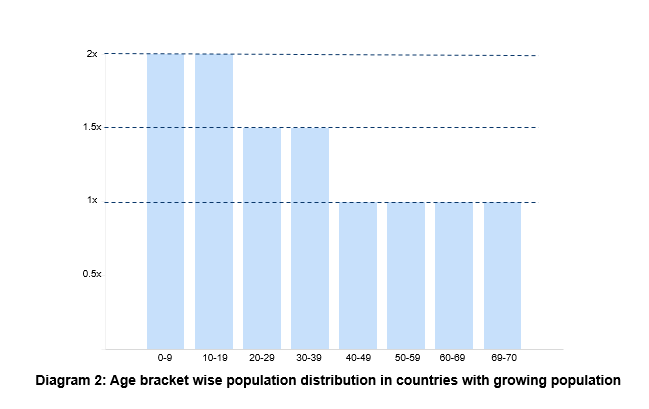
- Countries with increasing population
- Countries with declining population
- The countries within the two groups do not have a uniform age distribution. We have information about the age distribution in these two groups.
Share Exhibit 3 if the interviewee asks about the population of the countries in the two groups. Share Exhibit 4 if the interviewee asks about information on rotavirus disease.
Exhibit 1: Population distribution - Countries with increasing population
Now the interviewee must try to estimate the market size.
Below would be the steps:
- Calculating the population in different age segments by calculating 'x' and 'y' for the two groups
- Calculating the population between the ages 2 to 16 years
To calculate 'x' and 'y', we need to equate the total of all age brackets to the total population in that group:
Equation for 'x'2*(2x) + 2*(1.5x) + 4*(x) = 330 m11x = 330 mx = 30 mEquation for 'y'4*(0.75y) + 4*(1.5y) = 450 m9y = 450 my = 50 m
After calculating 'x' and 'y', we can now calculate the population for the relevant age brackets in the two groups.
We do not have an age bracket of 2 - 16 years in our population distribution chart. So we need to assume that the population is evenly distributed within 0-9 and 10-19 year age brackets in order to calculate the population between 2-16 years of age.
Below would be the main points to keep in mind for this calculation:
- 2- 16 years represents a 15 year time span.
- This time span is spread across 0-9 and 10-19 year age brackets. These two age brackets together cover a 20 year time span.
- In both the group of countries, the population in the 0-9 and 10-19 year age brackets is the same.
- We have already made the assumption that the population distribution within an age bracket is even.
For countries with growing population
Total population between 2-16 years = 146.25 m
Key insight
The total potential market for the vaccine in Europe would be ~150 m (146.25 m) customers.
2. Sales Forecast for Year 1
What would be the expected sales of the vaccine in year 1?
Information that can be shared if enquired:
- Currently, none of the other pharmaceutical companies have a similar product.
- The vaccine is administered in 3 doses at 6 month intervals. All the three doses together costs 100 € for the patient.
- This course of the vaccine protects the children throughout their lifetime.
- The customer pays after each dose is administered. However, the company plans to launch a pre-paid program for the doses in the subsequent years in order to encourage parents to take all three doses. The vaccine is not effective if only 2 doses are administered.
- Although there are differences in purchasing power of customers across the various countries, for the purpose of this case it is assumed to be uniform. Therefore, the purchasing behavior would be similar across countries.
Exhibit 5: Comparison of treatment costs
Below would be some of the key inferences from the information shared:
- The information given about the probability of the disease occurring and the treatment cost would give an indication about the likelihood of purchase of the vaccine.
- Since the incidence of the disease is higher at younger ages, it would be a sound assumption to make that the parents of the younger children are more likely to purchase the vaccine.
No. of customers - 2 to 6 years age bracket:Customers = 150 m / 15 * 5 * 45% = 22. 5 mNo. of customers - 7 to 11 years age bracket:Customers = 150 m / 15 * 5 * 35% = 17. 5 mNo. of customers - 12 to 16 years age bracket:Customers = 150 m / 15 * 5 * 10% = 5 mTotal customers = 22.5 m + 17.5 m + 5 m = 45 mTotal Sales = 45 m * 100 €€= 4.5 B
Sales in Year 1 = 4.5 B € * 2/3 = 3 B €
The key point to keep in mind is that once all the children (who are likely to purchase the vaccine) in the initial years have been covered, the new sales would come from children who turn 2, as all the older children would have already been covered under the vaccination program.
The number of children who turn 2 ( assuming the birth rates remain unchanged) can be calculated as follows:
New customers = 150 m * 1 year / 15 years
New customers = 10 m
Assuming that the incidence pattern of the disease remains unchanged and therefore only 45% of the parents are willing to buy the vaccine:
Customers = 45% * 10 m = 4.5 m
Sales = 4.5 m * 100 € = 450 m €
3. Conclusion
The candidate must now succinctly lay out the conclusion:
- The total potential number of customers is ~150 m
- The incidence of the disease is higher in younger children and steadily reduces. Therefore, it is likely that a higher percentage of children in the younger age brackets are likely to be vaccinated
- Given the incidence pattern of the disease, about 45 m children are estimated to be the potential customers in Year 1
- As only two doses are administered in Year 1, this would amount to a sale of 3 B €
- After a few years, the sales would stabilize at 450 m €